
In Chad, mobile clinics spare mothers and infants a long donkey-ride on vaccination days
In Chad, Africa’s fifth-largest country, where the under-five mortality rate still hovers around 100 deaths per 1,000 live births, access to vaccination remains a major challenge. In the east of the country, near Adré, a mobile clinic is reaching even the most remote populations.
- 2 November 2026
- 4 min read
- by Frédérique Prabonnaud
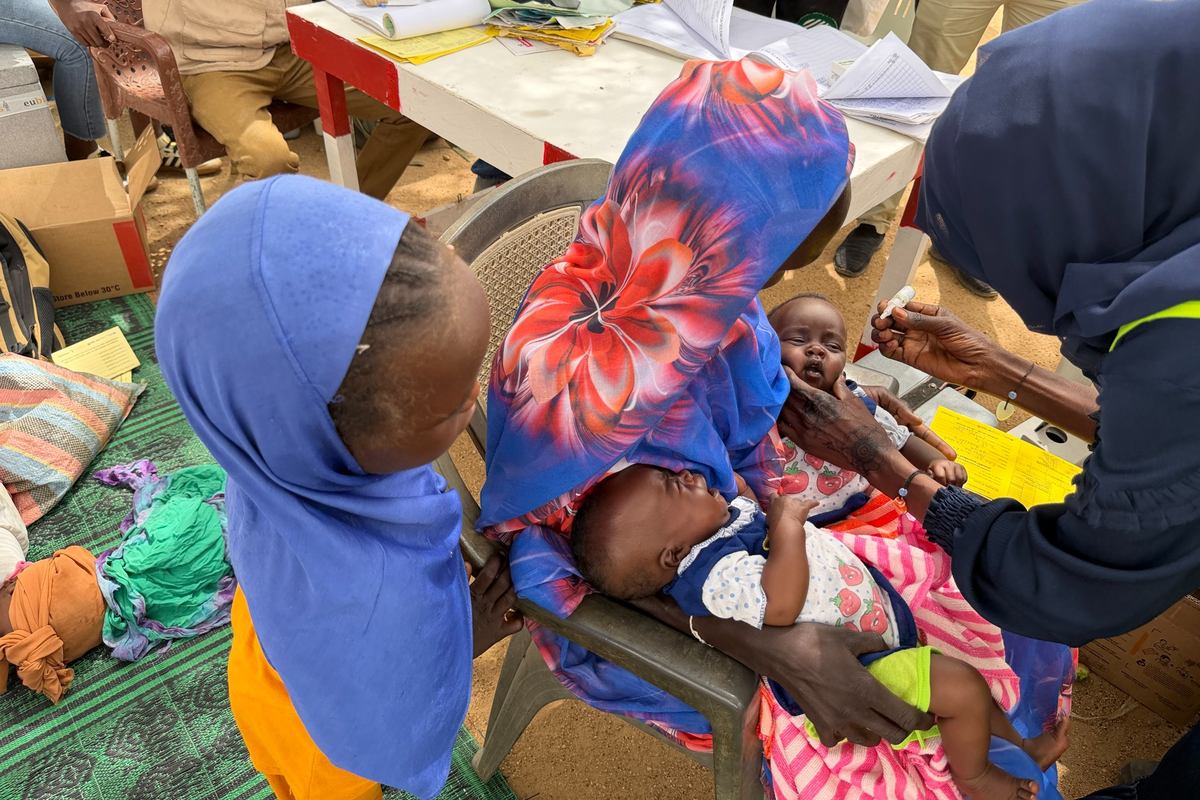
Seated on a plastic chair, Fatimé Mahamat Issaka holds her twins on her lap, each child circled in one arm. One drop is administered in Housna‘s mouth, one in Hassaniye‘s: the two six-week-old babies have just received a dose of the oral polio vaccine.
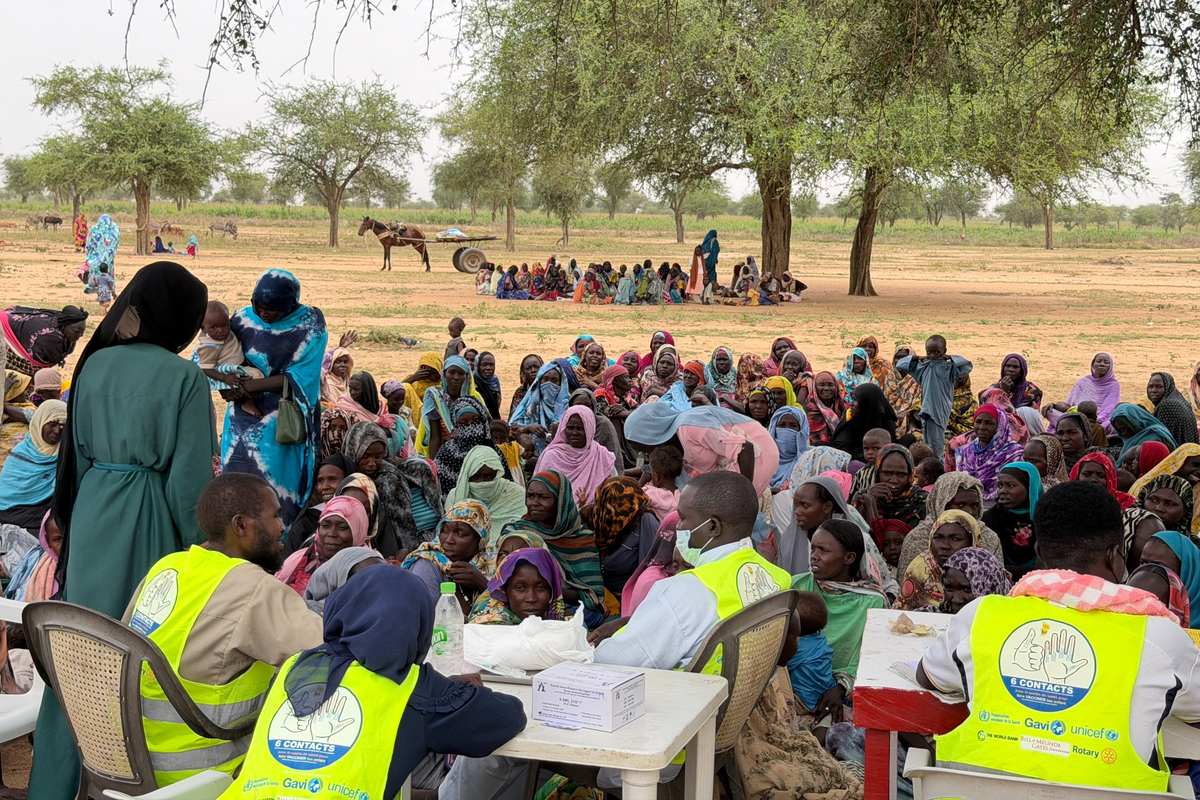
This is not a health centre, but a spot under a large tree in the centre of the village of Tchoukouya, population approximately 2,500, about 20 km from Adré in eastern Chad.
About a hundred women have gathered in the shade on colourful mats with their children. “Stay seated, dear mothers,” Clément Altorngaye calls through a megaphone. “The important thing is the vaccination of the children; that’s why we’re here!”
Altorngaye, the head of the Hilouta Health Centre has come with his team, equipment, and coolers containing vaccines: this is the monthly mobile clinic.
“It’s eight kilometres from here to the health centre,” explains Altorngaye. “For a mother, that means more than four hours of walking! So we opted for this approach: going to the mothers, and helping them get their children vaccinated as usual.”
For mothers like Fatimé, it’s a relief. She says she has never been to the health centre with her babies. “They‘re too young. It’s far away; I’d have to put one in front of me and one behind, on a donkey. It’s better if the doctors come here!”
“This community needs support, especially in the areas of vaccination and primary care, so here we provide routine vaccinations for children aged 0 to 11 months, 11 to 23 months, and catch-up vaccinations for children aged 59 months,” explains Altorngaye. Each child’s vaccination card is filled in, and so is the health centre’s daily vaccination log. A prenatal consultation is offered by a nurse at a folding table, located a little apart from the main clinic. The mobile clinic also screens for malnutrition and provides basic healthcare.
On the march against polio
Among the priorities of the mobile clinic is vaccination against poliovirus, which attacks the nervous system and can lead to irreversible paralysis.
Chad is free of the wild-type virus, like the rest of Africa, but variant poliovirus continues to circulate. 45 cases were reported in children in 2025 and 9 so far this year. “Transmission persists mainly in communities where too many children are not sufficiently vaccinated,” explains Dr Lusamba Kabamba, coordinator of the rapid polio response team at WHO Africa. “Strong herd immunity is essential to prevent the emergence and spread of these variants.”
Dr Antoine-Marie Cyrille Ziao, head of the immunisation unit at UNICEF Chad, adds: “When we are in an area where routine vaccination coverage is still low, this is what can lead to these cases of vaccine-derived polio. Therefore, we must strengthen routine immunisation: as long as vaccination coverage is low, there will always be outbreaks. So, the foundation is routine vaccination, and a child normally receives four doses of oral polio vaccine (OPV) and two injectable doses.”
Thanks to mobile clinics, adds this doctor, who has been involved in the fight against polio for over 25 years, the health system is able to reach even populations who are kilometres away from health centres.
Have you read?
Meeting people where they are
“This is clearly an opportunity that really needs to be explored more broadly,” says Dr. Antoinette Demian, “because moving a mobile clinic allows us to bring a health centre to the population.” As Director of Disease Control, Vaccination and Epidemiological Surveillance at the Chadian Ministry of Health, she explains that moving a clinic is expensive, but that “regular visits allow us to vaccinate children, provide prenatal consultations for pregnant women, consultations for women who have already given birth, and consultations in general.”
Mobile clinics target residents of remote villages, as well as nomads living far from health centres, and refugees, in a country that hosts approximately 2.25 million forcibly displaced people.
In the east of the country, on the border with Sudan, which has been at war since April 2023, more than 900,000 new arrivals have been registered across the entire territory.
Fatna Abakar Ibrahim, 35, is one of these Sudanese who fled the war in their country: for the past three years, she has lived in the village of Tchoukouya with her six children. The eldest, ten years old, is not vaccinated – “I couldn’t find anywhere to get vaccinated in Sudan,” explains his mother. But the youngest, 21 months old, is up to date on all his vaccinations, thanks to the mobile clinic.
“To be honest, I wouldn’t have gone to the health centre every time on foot or with a donkey,” admits the mother, “so this vaccination service in the village is really great for us!”
This story was told with the support of the United Nations Foundation