
Extreme poverty locked a family out. Lesotho’s frontliners found the means to bring them back in
In Lesotho, a team of nurses realised that dire poverty had pushed one family out of the reach of even free public healthcare. They resolved to bridge the distance themselves.
- 26 February 2026
- 6 min read
- by Pascalinah Kabi
At a glance
- A nationwide measles-rubella vaccination campaign last October brought a left-behind family from Leribe district, Lesotho, to the attention of local health workers
- Mabafula Ntšihlele and her ten children were living in such destitution that the USD 1.50 fee for an immunisation booklet, or the bus fare to a health facility, were well out of reach
- Health workers brought vaccines to the doorstep – and then went several steps further, raising donations of food, clothing, bedding. The aim, according to ‘Mamoferefere Zim, the head of nursing at the nearest hospital, was to protect not just the family's health, but their dignity, too
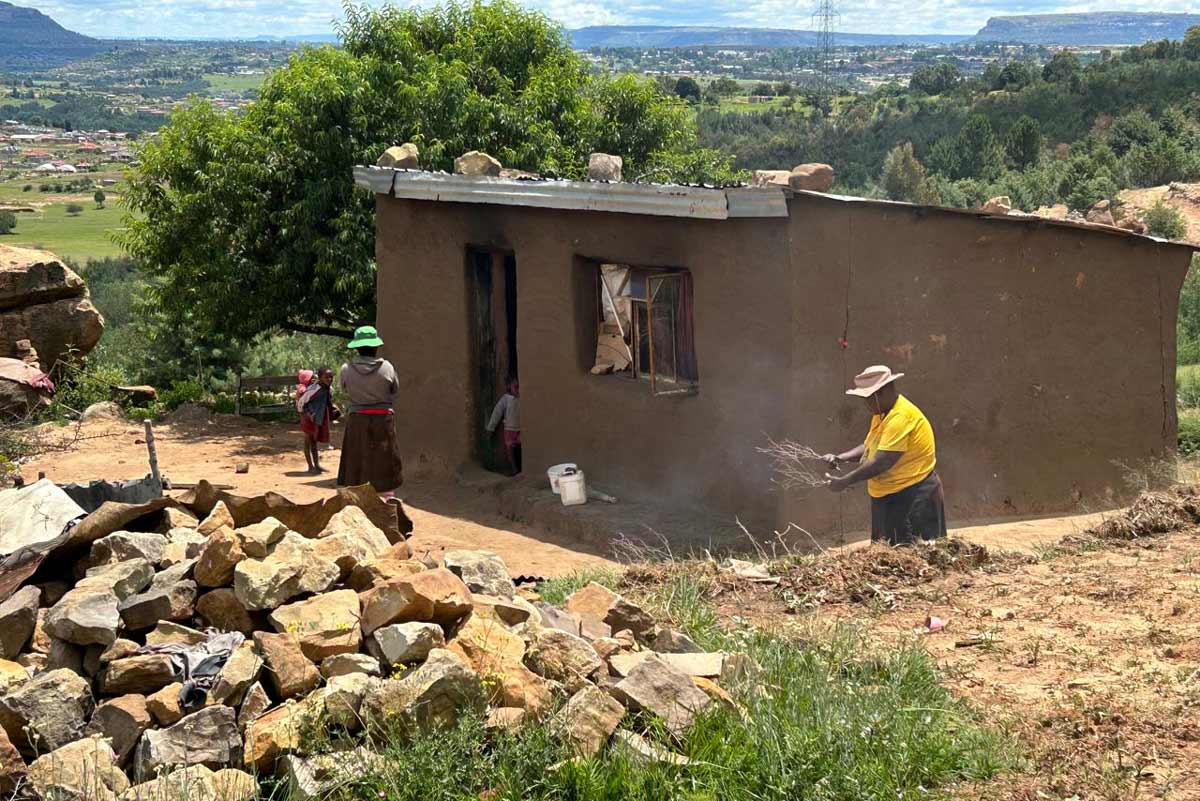
A single-room, brown clay structure serving as both kitchen and bedroom stands alone on the forested slopes of the Fothane Hills in Khanyane, a rural community in Lesotho’s Leribe district.
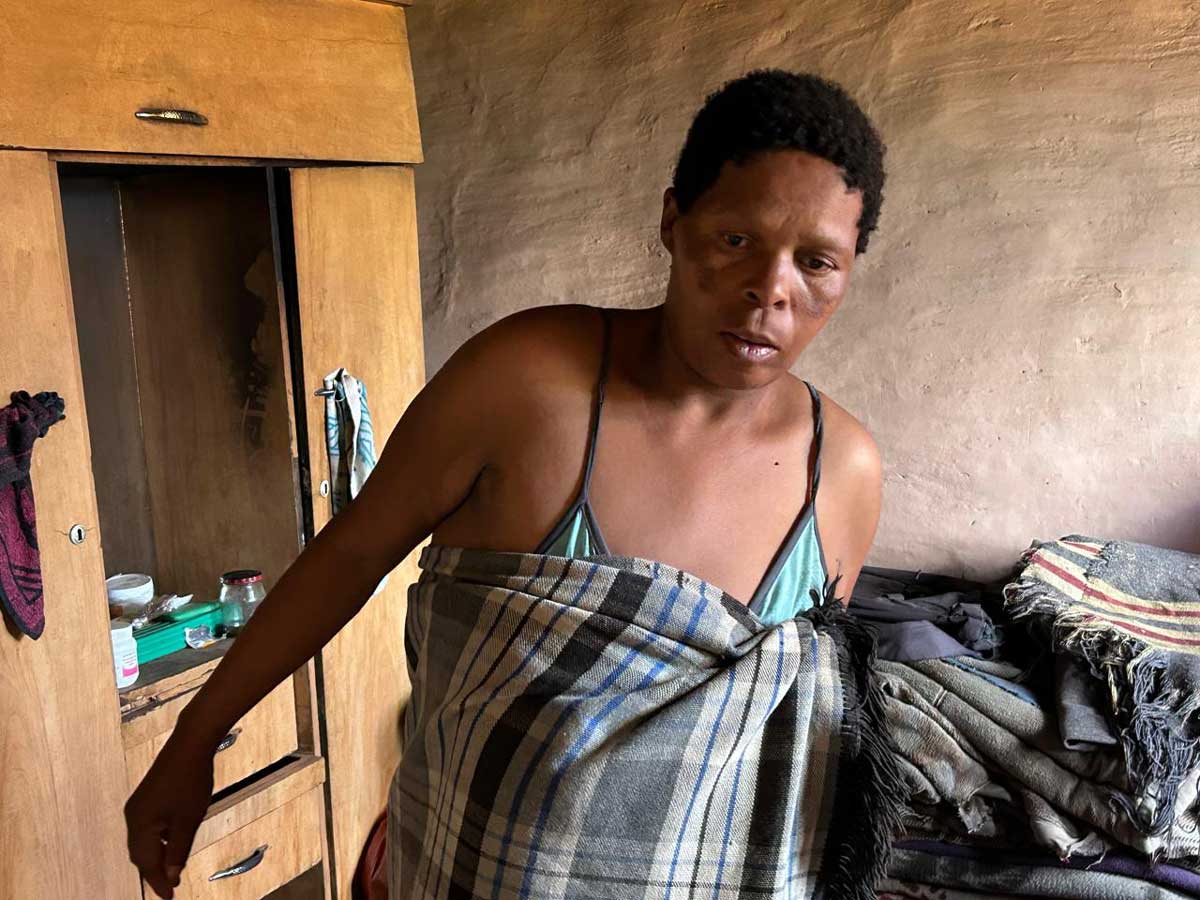
Life unfolds quietly around the house. Outside, three young children, all under the age of five, kick up dust as they play barefoot near the doorway. Inside, their 35-year-old mother, Mabafula Ntšihlele, lies on her left side on a double-sized bed, breastfeeding her youngest child, just one month old.
The light filtering through the single window above her bed softens the dim, sparsely furnished room, thick with the smell of wood smoke – a space where daily life, rest and survival blur into one.
“I have ten children. Five were born in hospital, and five were born at home because I did not have money for transport,” Ntšihlele said. She lives approximately ten kilometres away from the nearest health facility – Motebang Hospital.
She explained that until the end of October 2025, none of her children had received routine childhood vaccinations – not because of belief or neglect, but because of poverty. She could not afford the medical booklet required at health facilities, which costs about US$ 1.50, nor the return transport fare of roughly US$ 1.60 to Motebang Hospital.
For Ntšihlele, these small sums – less than the cost of a meal in many parts of the world – became prohibitive, leaving her children beyond the reach of lifesaving healthcare.
“I survive on piece jobs, and whatever I earn is used to buy a single kilogram of maize meal for my children to eat,” she told VaccinesWork last November, barely a month after Lesotho had concluded a nationwide measles and rubella vaccination campaign.
When absence raised alarm
Between 20 and 25 October 2025, Lesotho conducted an intensive nationwide measles and rubella vaccination campaign. Village health workers were instructed by Minister of Health Selibe Mochoboroane to ensure that no child was left unvaccinated.
“To village health workers: you know every child under the age of five living in your village. We do not expect even a single child to miss this vaccine,” Mochoboroane urged during his address at the campaign launch.
Khanyane village health worker Makoetle Koetle took the directive seriously. When Ntšihlele’s under-five children did not appear at the temporary vaccination point in the village, Koetle alerted the nursing staff.
“Children feel pain when they see other children receiving services while they are excluded. That is why I reported the family to the nurses,” Koetle said.
The report reached ’Mamoferefere Zim, the manager of nursing services at Motebang Hospital and supervisor of the campaign in Leribe district.
“Even though I was informed that the village was inaccessible by car, I felt compelled to visit,” Zim said.
A difficult journey, a stark reality
The journey was arduous. Zim and her team crossed a stream and walked through forested paths to reach the homestead, hoping to understand why the children had been excluded from vaccination services.
When they arrived, they found four children under the age of five – a two-week-old newborn, an 18-month-old toddler, a three-year-old child, and another just under five. None had medical booklets.
Zim was first received by Ntšihlele’s husband, who expressed no objection to vaccinating the children. As she prepared to leave, he asked her to enter the house to speak directly with Ntšihlele.
Inside, Zim encountered conditions she described as deeply distressing. The family asked whether arrangements could be made for Ntšihlele to be permanently sterilised. Zim observed a single thin mattress – it was unclear who slept on it – and worn-out blankets that were unlikely to be sufficient for the household.
“It was evident that there was no maize meal in the house, not even enough for one meal. The children had no adequate clothing,” Zim said.
By the end of the visit, an agreement was reached: nurses would return to the homestead to vaccinate the four under-five children, including administering a BCG vaccine to the two-week-old baby. Zim also facilitated the provision of medical booklets for the children and for Ntšihlele herself.
Have you read?
Beyond vaccination
“After assessing the situation, it became clear that this was not simply a case of a mother failing to take her children for vaccination,” Zim said. “When putting food on the table is a daily struggle, walking long distances with young children for immunisation is not easy.”
Zim said her assessment concluded that poverty was the primary barrier. The children were subsequently vaccinated, and she coordinated with doctors at Motebang Hospital to support Ntšihlele’s request for permanent sterilisation. Ntšihlele was transported from her home, admitted, and the procedure was carried out.
While Ntšihlele was hospitalised, Zim appealed to fellow staff members for assistance. Civil servants responded, donating food, clothing, blankets and a bed – on which this reporter later found Ntšihlele sleeping in November 2025.
“The response went beyond the call of duty and helped restore the family’s dignity,” Zim said. “When Ntšihlele was discharged, she returned home with these donations. What remains now is to ensure the children continue receiving their routine vaccinations.”
Zim said the case reflects a broader challenge within the health system. “Often, we focus on delivering services, yet people fail to access them because they cannot afford to come,” she said.
Drawing on her experience in community health, Zim explained that poverty is frequently the most prohibitive barrier. “For a woman like Ntšihlele to bring three children for vaccination, she needs transport money. She must be able to feed her children while waiting. She needs nappies, clean clothes, and dignity. At the clinic, the cost of poverty becomes visible.”
A changed outlook
Ntšihlele says she is now confident she will be able to take her children for routine immunisation.
“I always wanted my children to be vaccinated. Now that they have medical booklets, I will borrow money for transport to Motebang Hospital if I have to,” she said.
She credits nurses and village health workers for support that went beyond medical care. “They did not only help with booklets. They brought food, clothes, a bed and blankets. They could have left after vaccinating my children, but instead they took pictures of my house so they could ask others for help,” Ntšihlele said.
“At that time, we had gone two days without food. Now I do not worry the same way.”
She says the change is visible in her children. “When I returned from the hospital, my children were thin and there was no food. Now I can see the change in their bodies – their weight is improving. It is a huge relief. Right now, I am not stressed.”
More from Pascalinah Kabi