
After the flood, Nepal braces for disease outbreaks
A catastrophic flood in Nepal has killed thousands already. Now, a grave public health crisis threatens.
- 18 September 2026
- 6 min read
- by Pragya Timsina
At a glance
- The collapse of a glacier triggered a flood that has killed more than 1,500 people in Nepal, leaving 6,150 people still unaccounted for. An estimated 32,000 people have been displaced, with more than 80,000 in need of aid.
- While early response efforts have focused on search-and-rescue, health leaders say that efforts to control the spread of infectious disease in the flood zone have been underway since the beginning. Vaccination campaigns are ongoing.
- Researchers emphasise that the glacier’s collapse is a climate change-linked event. As global temperatures continue to rise, it’s unlikely to be the last disaster of its kind.
The morning of August 26 was fine and clear until suddenly it wasn’t, recalls Bishal Khadka, a bank branch manager in Timmure, Rasuwa, in Nepal’s Bagmati Province. He had just arrived at the office and was settling in when his chair lurched beneath him. He thought it was an earthquake, and dashed out of doors.
A security guard working in the same building ran out calling to him: “Sir, run fast, it’s not an earthquake. Something very huge – a mass – it’s coming to us from the sky from China’s side.”
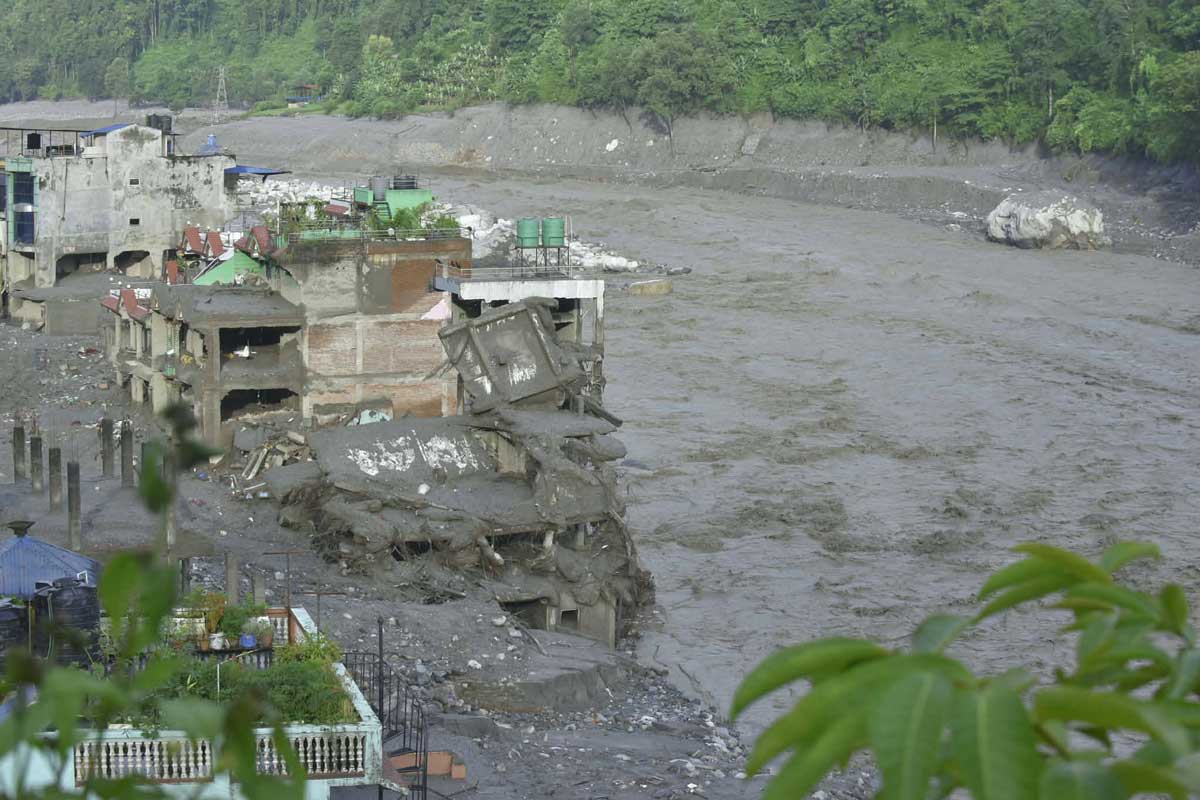
The mass was sludgy water, charged up with solid debris; a flood was sweeping away everything in its path. Khadka said he saw a muddied car fly out of nowhere and land in the road.
Khadka and the guard ran uphill, through thorny scrub. When they paused to look back they saw Timmure had been washed away.
A “Himalayan Tsunami”
Timmure is the first village in Nepal after crossing the China border. The disastrous flash flood of 26 August is believed to have been the result of a glacier collapse on Mount Langtang Lirung, which is situated on the Nepal-China Border.
Locals said the flood covered the 80-kilometre distance from Rasuwagadhi to Devighat Bazaar in a mere 25 minutes.
More than 1,500 people have been reported killed, with 6,150 people still unaccounted for in Nepal, according to government estimates.
At the time of writing, 13,583 people had been rescued and 3,240 people were taking shelter in 1 of 17 holding centres. Five districts, 15 municipalities and 49 wards have been directly affected, with an estimated population of 32,000 facing displacement. According to the United Nations Development Programme, more than 84,000 people are in need of aid.
Experts here in Nepal have described the catastrophe as the “Himalayan Tsunami”, and have clearly identified it as a climate change-linked event. As global temperatures rise, glaciers across the Hindu Kush Himalaya mountain range – which spans Afghanistan, Bangladesh, Bhutan, China, India, Myanmar, Nepal and Pakistan – have lost ice 65% faster between 2011 and 2020 than during the previous decade. Nepal alone has lost close to one third of its ice volume in roughly three decades, the United Nations said in 2023.
The greatest irony is that Nepal contributes less than 0.1% of global greenhouse gas emissions, which is thought to be the most important contributor for global warming. That means the people of Nepal, and people from elsewhere in the Himalayas, are paying the price for a problem created elsewhere. The total economic losses for Nepal subsequent to the flood are estimated at US$ 2.70 billion. Those losses aren’t static. The damage sustained by no fewer than 13 hydropower facilities and projects, for instance, will jeopardise Nepal’s energy strategy, which will, in turn, have bearing on the national budget and consequently on health systems in general.
Round two: a wave of disease
The second-round dangers are still gathering speed.
The floodwaters travelled at a pace of approximately 180 km/h per hour, sweeping away houses, people, livestock, food grains and other belongings. All that biological debris has now started to decompose.
Dr Dipendra Pandey, a senior orthopaedic surgeon who recently visited the epicentre of the disaster in Rasuwa and Nuwakot districts shared his experience with VaccinesWork. “I had actually visited those districts to provide aid in trauma care,” he said, “but what I found was that almost all parts of the river bank is smelling very bad with dead bodies. Water sources supplying the living [people] are almost all contaminated. Displaced people lack even the basic facilities to maintain their health hygiene. So I fear there might be infectious disease outbreak in those areas.”
To complicate matters further, health service infrastructure has been severely affected in the disaster-hit areas, with four health posts fully damaged, at least one hospital partially damaged and access to two further hospitals compromised. Many of the health workers now rushing to the aid of the displaced are victims of the disaster themselves.
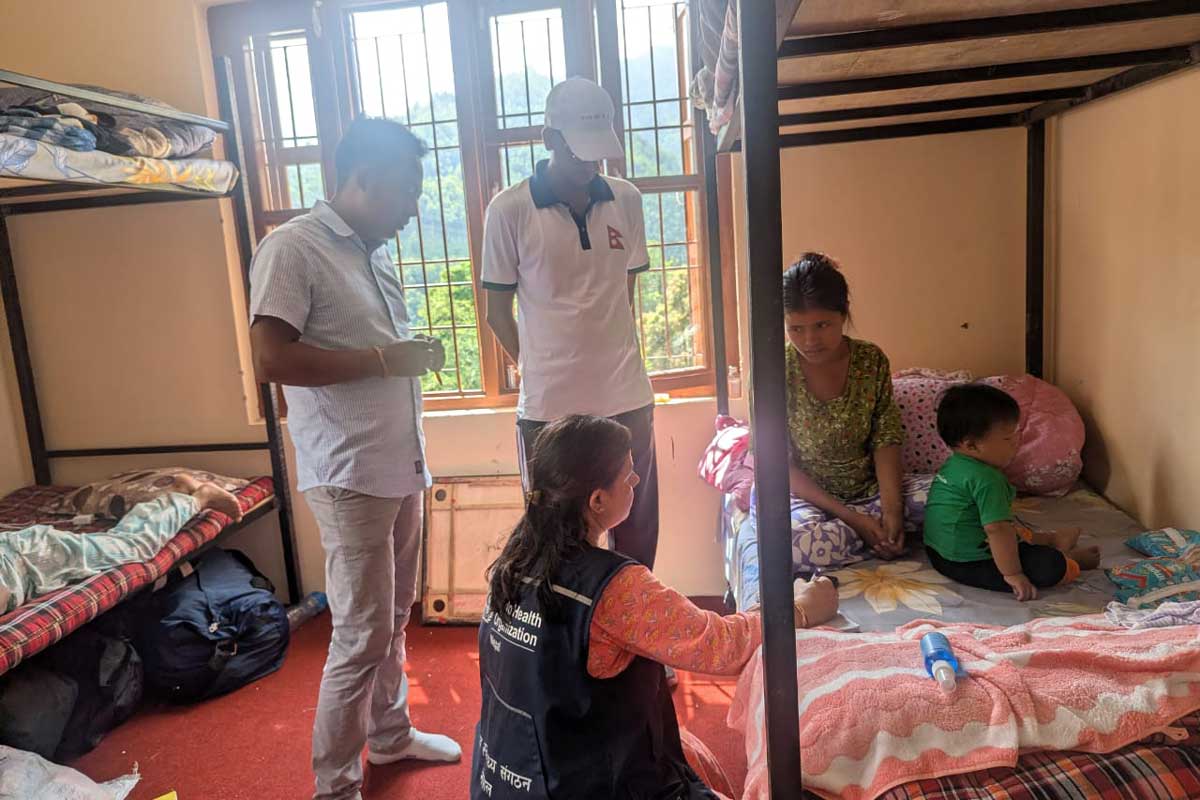
Unnati Maharjan, Public Health Officer at Rasuwa District, highlighted some emerging public health issues at the affected areas. Thousands of people have sudden lylost their homes, which means they are either in holding centres prepared by government, gumbas (sacred Buddhist monastery compounds) or in their relatives’ houses. The upshot is crowding. Diarrhoeal illness, viral respiratory conditions and fungal infections are far more likely to spread quickly under these conditions, and are already doing so.
According to Maharjan, children living at a holding centres on the grounds of Nilakantha Higher Secondary School in Rasuwa developed fevers and rashes, which rapidly spread among them. Suspected to have measles, infected children were kept at isolation and samples from four children were sent to Kathmandu for laboratory testing. Luckily, it turned to be a different, and less life-threatening viral illness.
Meanwhile, many in the geriatric and chronically ill population have lost access to their regular medication along with their homes. Health workers are struggling to get hold of the right prescription medicines in time.
And for many, financial losses have direct health impacts. Raj Kumar Dangol, who was scheduled to donate his kidney to his wife next month, had kept 2.5 million Nepali rupees at his home earmarked for the surgery. All that money has been lost. He became so hopeless that he started crying in an appeal video. The video went viral on various social media platforms. Afterwards, a few businessman pledged him to help him fund his wife’s renal transplant.
Have you read?
Sandbags against the tide
In the initial days, the major focus of the government was in rescuing the survivors and getting the injured treated in a timely manner.
Since all motorable roads were swept away by flood, rescue was possible only with the helicopters in the difficult geographical terrain of Rasuwa and Nuwakot districts.
Search and rescue work continues, in hopes that living people may still be surviving in the tunnels of the region’s hydropower projects.
Yet Dr Samir Adhikari, a spokesperson for the Ministry of Health, told VaccinesWork that the government was alert to the need to prevent the spread of infectious disease in the flood-affected areas from the earliest days of the disaster.
Water sources flowing toward the communities have been tested and rapidly decontaminated, he reports. Another focus has been halting the rapid growth of mosquito populations, in a bid to brake the spread of mosquito-vectored disease in the deluged zone. Extensive search-and-destroy vector management programmes have been conducted.
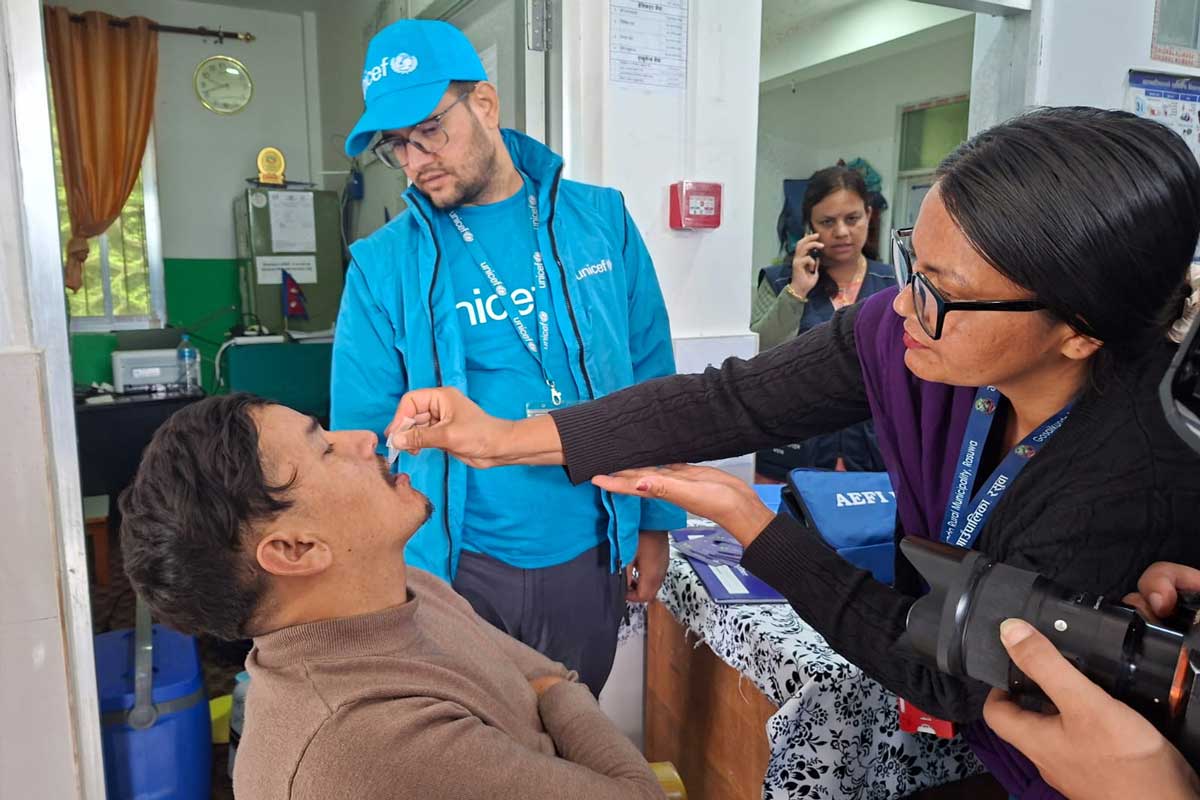
Similarly, the government has jumped to conduct mass vaccination in those hardest-hit areas. Dr Abhiyan Gautam, Chief of Child Health and Immunization Services said 21,000 and 80,000 doses of cholera vaccine have already been administered to the people of Rasuwa and Nuwakot districts respectively after the flood.
Apart from that, the government has said that all required medicines and health workers have been adequately deployed in the affected areas to address any sort of health-related issues. In meantime, public health experts already deployed to the field are closely monitoring the risk for any other potential disease outbreaks, says Gautam.
More from Pragya Timsina