
Getting beyond awareness: ‘learning by doing’ to reach zero-dose children in India
In Bihar and Uttar Pradesh, under-immunised urban communities are brought into a problem-solving process with a difference.
- 2 September 2026
- 7 min read
- by JSI
India has made remarkable progress in reducing the number of zero-dose children – those who have not received even their first dose of the basic diphtheria, tetanus and pertussis-containing vaccine (DTP) – living within its borders. As the country moves closer to reaching every child, new solutions are called for.
The reasons children are missed can vary considerably across communities and households, which means these solutions have to be responsive to local realities. In this context, we are sharing our experience of applying a ‘learning by doing’ approach in urban areas of Bihar and Uttar Pradesh – an approach that combined human-centred design with continuous learning to understand local barriers, co-create potential solutions and adapt them as implementation unfolded.
We mapped out potential solutions together with caregivers of zero-dose children, frontline health workers and government stakeholders. These interventions were then tested, refined and adapted based on ongoing implementation experiences and feedback.
Our approach was structured around three phases: Define, Design and Deliver (3D).
Define: Understanding the root causes of missed vaccinations
In the “Define” phase, the team set out to understand exactly why children in a given context were missing routine vaccinations. What we first heard from communities in Bihar and Uttar Pradesh largely reflected familiar reasons: low awareness about immunisation, limited understanding of vaccination schedules, fear of post-vaccination side effects and, in some cases, hesitation or resistance from caregivers, most commonly fathers.
However, when we began working in the urban areas of Bihar and Uttar Pradesh, it became clear that the awareness question was only one part of a much more complex reality.
We learned from households about everyday constraints that rarely appear in programme data. Time poverty came up repeatedly. For daily wage families, even one day spent caring for a child after vaccination could mean a direct loss of income.
Fear of post-vaccination effects, such as fever or swelling, not only triggered concern about the symptom itself, but also about what it meant for the household and who would manage it. For many women, especially working mothers, side-effects had the potential to pose very real problems, beyond caring for a sick child. As one mother shared: "if the child gets a fever after vaccination, everyone in the house blames me because I took the child for the vaccine."
Decision-making in the families we encountered was often collective. Elders often had a strong influence on whether a child would be vaccinated. In some cases, there was an unspoken expectation that immunisation would not provide a benefit as immediate or tangible as, for example, a ration of food. That shaped how households de-prioritised vaccination services.
It became clear that vaccination decisions were shaped not only by awareness of vaccination benefits, schedules, and service availability, but also by layered household, social and economic realities.
Design: Translating understanding into shared problem-solving
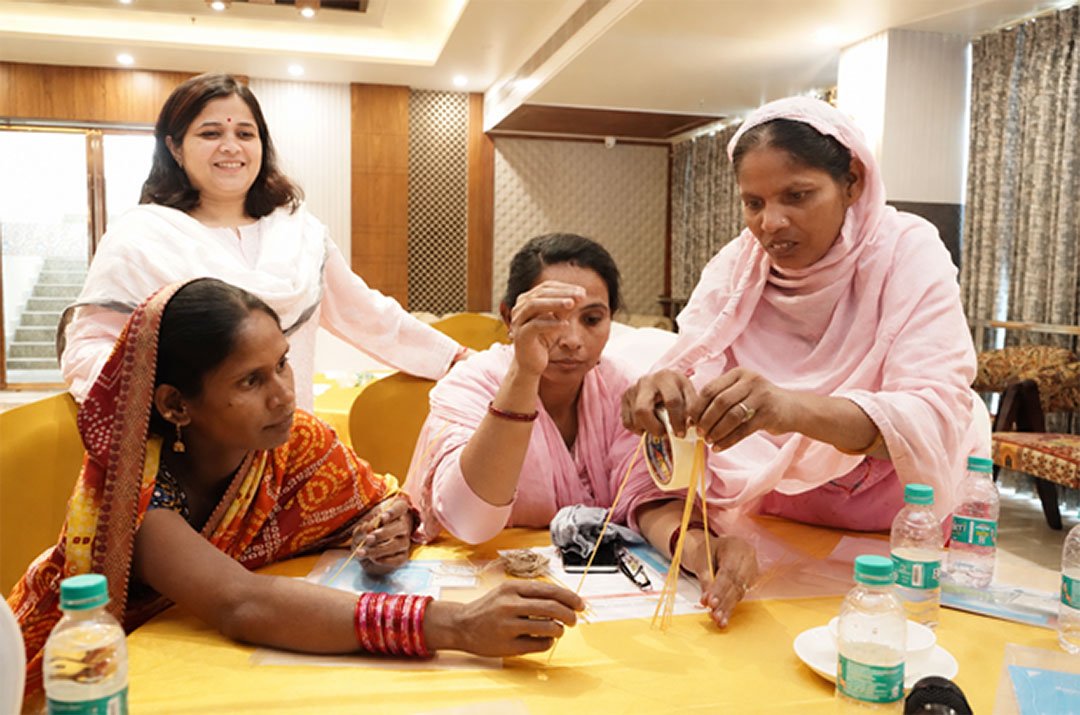
We believe that people facing challenges can provide some of the most practical and sustainable solutions to those challenges. To act on what we were hearing in communities, we sat with community members and health workers from the area and tried to understand which barriers were the biggest or most immediate blockers. That often meant listening to families’ experiences, drawing out where a decision was getting stuck, and then figuring out what might help.
Have you read?
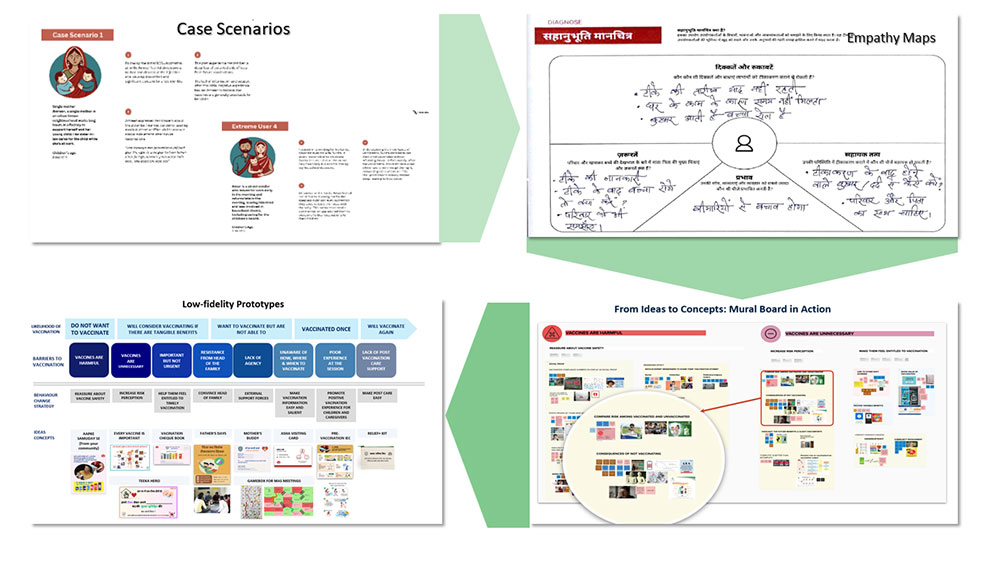
Through co-creation workshops, empathy mapping, and journey mapping, we translated lived experiences into clear points of friction in the vaccination journey, identifying where and how decisions were being shaped. This helped shift us from a broad problem to specific design opportunities.
We then tested those ideas with communities, refined them based on their feedback and iterated on what was understandable, acceptable and feasible in real contexts.
Credit: JSI
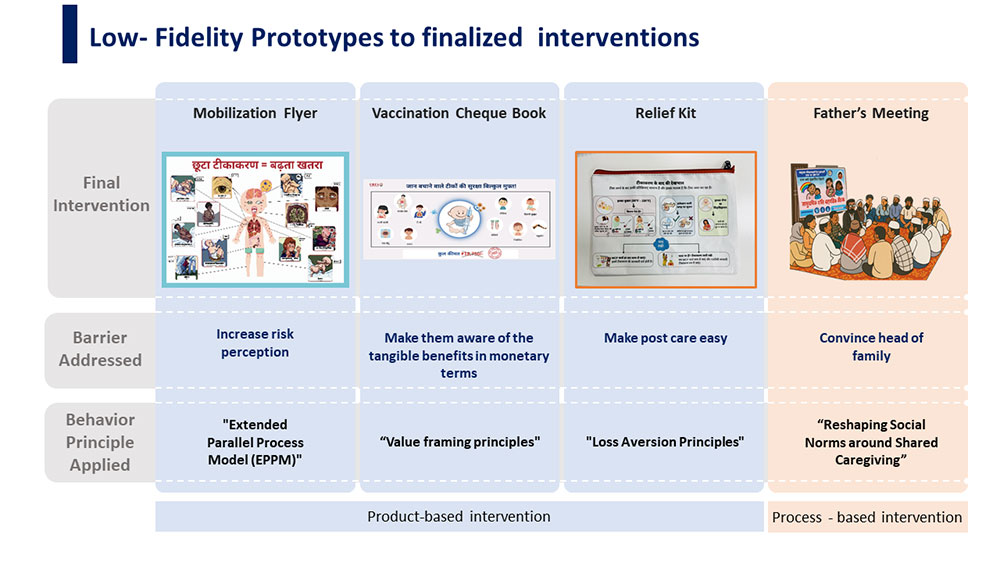
Here are examples of product- and process-based interventions that emerged through this iterative process:
- Mobilisation Flip Flyer: A visual tool designed to make vaccination schedules easier to understand and communicate during household mobilisation. It used pictures to show vaccine-preventable diseases and the protection a child gains through timely vaccination, helping health workers explain the importance of completing the vaccination schedule in a simple and accessible way.
- Teekakaran Chequebook: A booklet designed to reinforce the economic value of government-provided vaccines. It illustrated the monetary value of vaccines to help families understand the value of the services available to them and what they would otherwise have to pay for.
- Relief Kit: Co-designed in response to repeated concerns about post-vaccination fever and swelling. The kit was intended to address immediate anxieties around caring for a child after vaccination and contained paracetamol syrup and the Mother and Child Protection (MCP) Card. It provided caregivers with reassurance and reinforced the importance of retaining the child’s vaccination record.
- Fathers’ Meetings: A process-based intervention that evolved through testing different approaches to engaging male caregivers and household influencers. The meetings created a space for fathers to discuss vaccination concerns, share experiences, and learn from peers, while also opening conversations around child health more broadly.
Credit: JSI
Deliver: Continuously reshaping implementation based on experience
As implementation continued, frontline health workers were equipped to more effectively engage with vaccine-hesitant families during routine interactions.
User Advisory Groups (UAGs), comprising zero-dose caregivers, frontline workers, and government staff, became central to monitoring implementation, reviewing community feedback, and identifying emerging drivers of missed vaccination. They engaged through existing review platforms, such as monthly Urban Primary Health Care (UPHC) reviews. These shared spaces helped maintain a steady link between community realities and programme decisions.
Through these ongoing feedback loops, many of our earlier understandings began to shift. Fathers were not necessarily resisting vaccination; many simply did not have complete information about schedules or side-effects. Mothers were not necessarily hesitant; they were often managing the fear of being blamed if anything went wrong after vaccination. Within the same family, decision-making was layered and complex.
As our understanding deepened, we refined the interventions. We simplified the immunisation flyers to make information easier to understand, and the visuals were made clearer and more intuitive. The Teekakaran Chequebook and Relief Kit were adjusted for low-literacy contexts. We expanded our process-based interventions beyond fathers to include elders and other household influencers. Session timings were aligned with work routines, and discussions gradually broadened to include wider child health topics.
During these revision conversations, frontline health workers pointed out that combining complementary interventions could better address the barriers influencing vaccination decisions within a given household. So, implementation evolved towards a bundled approach. During household mobilisation, we used the Mobilisation Flip Flyer and Teekakaran Chequebook together to reinforce key messages, while Fathers’ Meetings integrated the product-based interventions to facilitate discussions and address concerns around vaccination.
Over time, as we focused less on implementing ‘fixed’ solutions and more on refining them based on how communities responded, we began to observe a shift among families who had previously hesitated to vaccinate and had been less willing to engage. That shift was measurable: every third zero-dose child from within this category of families began receiving vaccinations.
In our experience, iterative change, rather than any single intervention, appeared to contribute to greater engagement among caregivers. As communities saw their concerns reflected in the programme, trust grew, as did participation.
Solving problems with, not for, communities
The biggest barrier to reaching zero-dose children may not always be a community’s lack of awareness or access to services. It may also be health institutions’ and programme implementers’ limited understanding of the realities that shape decisions.
Initial assumptions help frame the problem, but real-world contexts require revisiting those assumptions to ensure the right problems are being addressed with the right solutions. So-called ‘demand-side barriers’ are really the interactions of household relationships with economic pressures and lived experiences of caring for children. These layers became visible to us as we engaged with communities throughout the phases of the process.
By involving communities not just as recipients but as active participants in shaping, testing and refining ideas, the interventions became more grounded in communities’ lived realities and ownership. We saw demand increase, and more children received life-saving vaccines.