
In northern India, Rohingya refugee families find certainty in one thing: the health system
Through government health centres and door-to-door visits by frontline health workers, otherwise “invisible” Rohingya refugee children in Jammu are receiving routine vaccines.
- 29 October 2026
- 7 min read
- by Raihana Maqbool
At a glance
- Tens of thousands of Rohingya refugees have fled Myanmar for India. About 7,000 of them live in Jammu, in the country’s north
- For those refugees who lack formal residency paperwork, gaining access to life’s necessities can be difficult. But one thing Rohingya mothers report accessing without much trouble is immunisation.
- For years, a dedicated chain of frontline health workers have made it their business to find these vulnerable families and bring them under the protection of vaccines. It’s working: coverage is high, and so is trust.
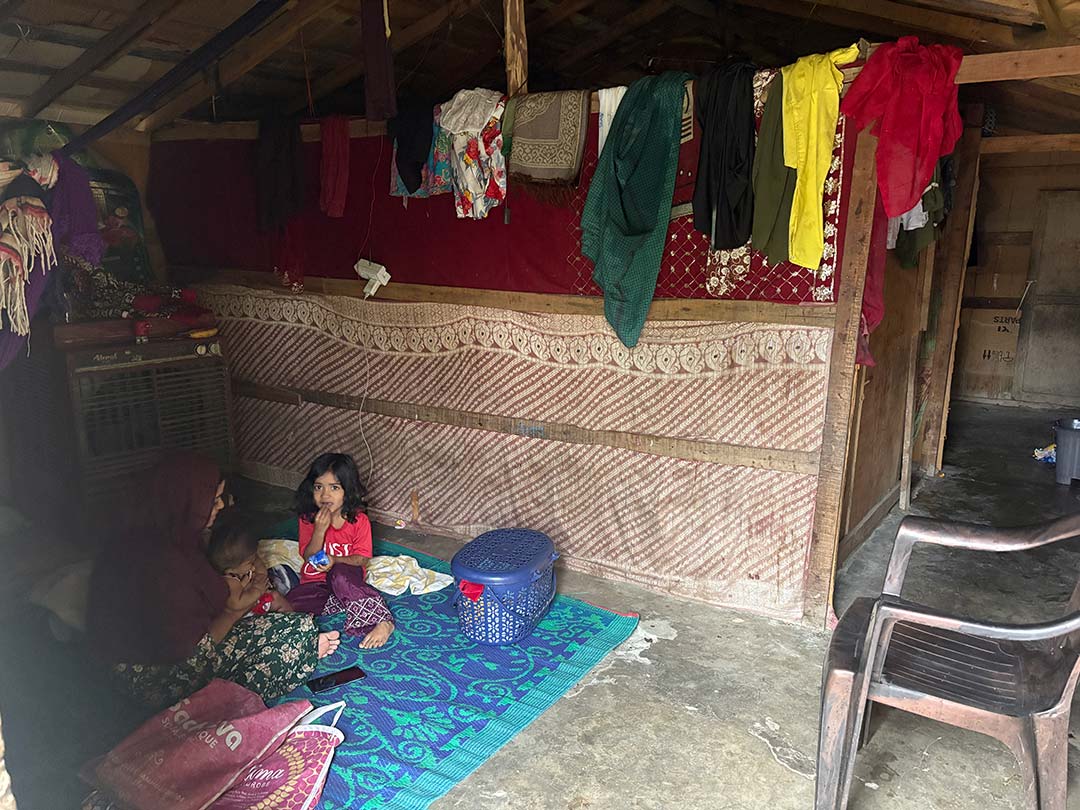
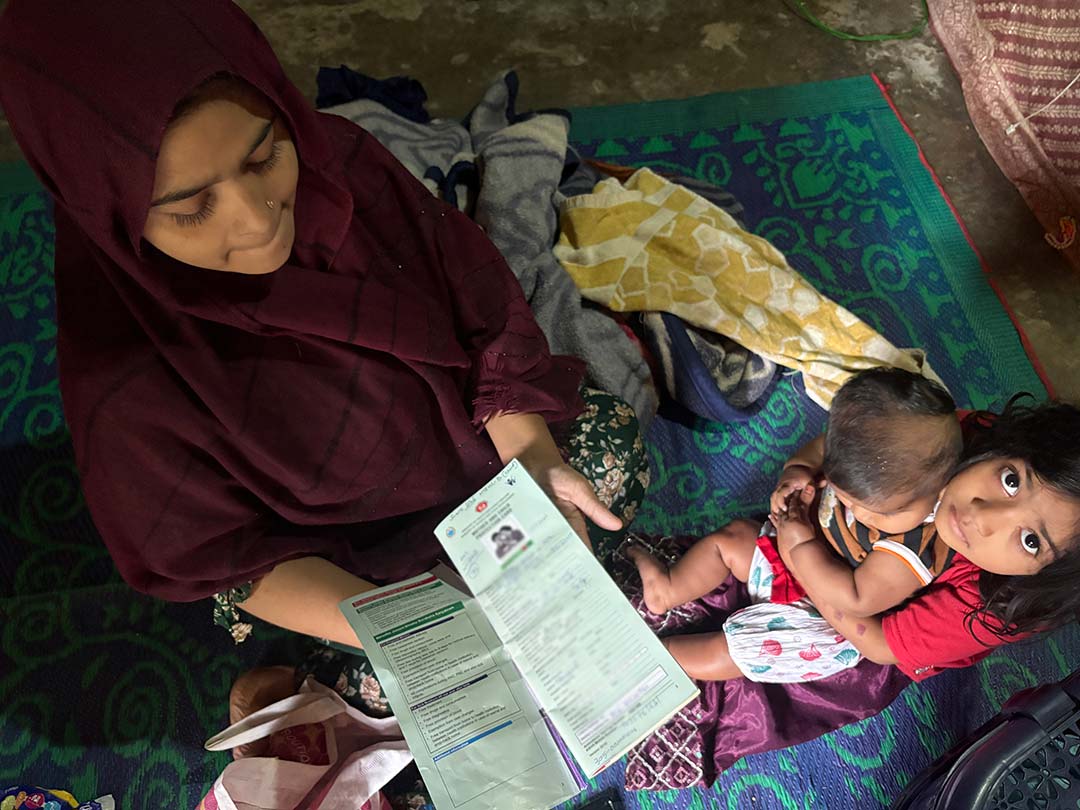
Many things are uncertain for 25-year-old Rashida Begum and her two children. In a small, improvised tin-and-wood shed in Karyani Talab, a locality in Jammu, northern India, she feeds her three-month-old while her four-year-old daughter sits beside her.
She can’t say whether the children will be allowed to receive an education since they, refugees like their mother, are on wobbly legal ground in India.
Rashida herself never went to school. She was three when her parents fled Myanmar’s Rakhine State and sought refuge in Jammu, and she has lived in an informal Rohingya refugee settlement ever since.
The Rohingya, a persecuted Muslim minority from Myanmar, have fled decades of violence and displacement, with many seeking refuge in countries including Bangladesh and India. A 2021 report by Human Rights Watch says that an estimated 40,000 Rohingya refugees live in India, among whom 20,000 are registered with the UN refugee agency.
In a future wreathed in doubt, Rashida is certain of at least one thing: the children will be protected from preventable illnesses.
She learned about vaccines from an Accredited Social Health Activist (ASHA) worker who came to the camp when she was expecting her first child. “They taught me about how important immunisation is, and they continue to do so,” she says.
“Three months ago, I gave birth again, and this time I knew which vaccines my child needed.” Rashida’s family lives without land, formal documents or legal certainty. Yet her children have immunisation cards, which they received on the strength of a card issued by UNHCR, the UN’s refugee agency.
Credit: Raihana Maqbool
Across Jammu, which is home to about 7,000 Rohingya refugees, a chain of ASHA workers, Auxiliary Nurse Midwives (ANMs) and government health centres is managing to reach children who are largely invisible to the administrative system.
But that chain is now under strain. Landowners have asked refugees to vacate, and families are scattering into rented rooms across the city. The health workers who have spent years learning where every child lives must find them all over again.
Accessing government health services
According to UNICEF and the World Health Organization (WHO), India reached 97% of its children with vaccines in 2025. India’s great population size makes that an extraordinary feat in absolute terms: the country vaccinates around 26 million children and 29 million expectant mothers across 1.2 million immunisation sessions each year. As per the Health Ministry, this makes India’s immunisation programme the biggest public health effort anywhere in the world.
The spread of the health system’s footprint is part of what facilitates that project. While their legal “invisibility” risks consigning Rashida and her family to the ranks of the “hard-to-reach,” proximity to care counterbalances it.
The Bhitindi area of Jammu has several Rohingya settlements, locally called jhuggis. Rashida’s jhuggi is an easy walk away from the nearest health centre.
“The health centre is nearby, so it is easy for us to take our children for immunisation, even if we miss a scheduled vaccination. We can easily find the health workers here, and the process is straightforward. I had no difficulty getting immunisation cards for my children,” Rasheeda told VaccinesWork. “I showed my UNHCR card and registered.”
Making it easy to get vaccinated is a question of policy. Minister of State Anupriya Patel said in the Rajya Sabha, India’s upper house of parliament, that Jammu & Kashmir recorded a 100% overall full immunisation coverage for 2025–2026. She added that under Mission Indradhanush, a catch-up campaign, extensive door-to-door surveys and beneficiary tracking led to the identification of over 32,000 children requiring vaccination support.
How frontline health workers help families stay on schedule
Dilraaz Begum arrived in Jammu from Myanmar in 2012, after crossing mountains and borders and walking for days. “When I came here, I faced many issues; I had no documents,” she recalls.
She and her six children have moved between three makeshift settlements in Jammu since then, but she has immunised all of them. She gives credit to the frontline health workers who have helped her keep the children on track.
Have you read?
“I had to show the card issued by UNHCR at the health centre, and they gave us an immunisation card. All my children have immunisation cards from the Ministry of Health. If I missed a vaccine, the ASHA worker would come to the jhuggi and vaccinate the children,” she says.
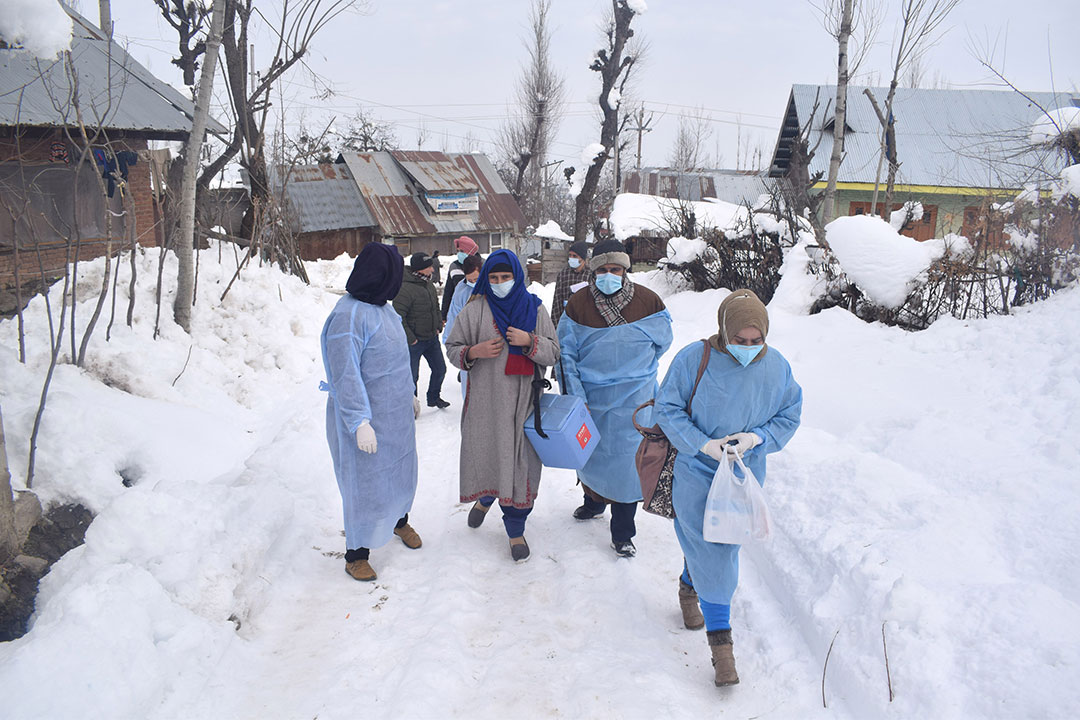
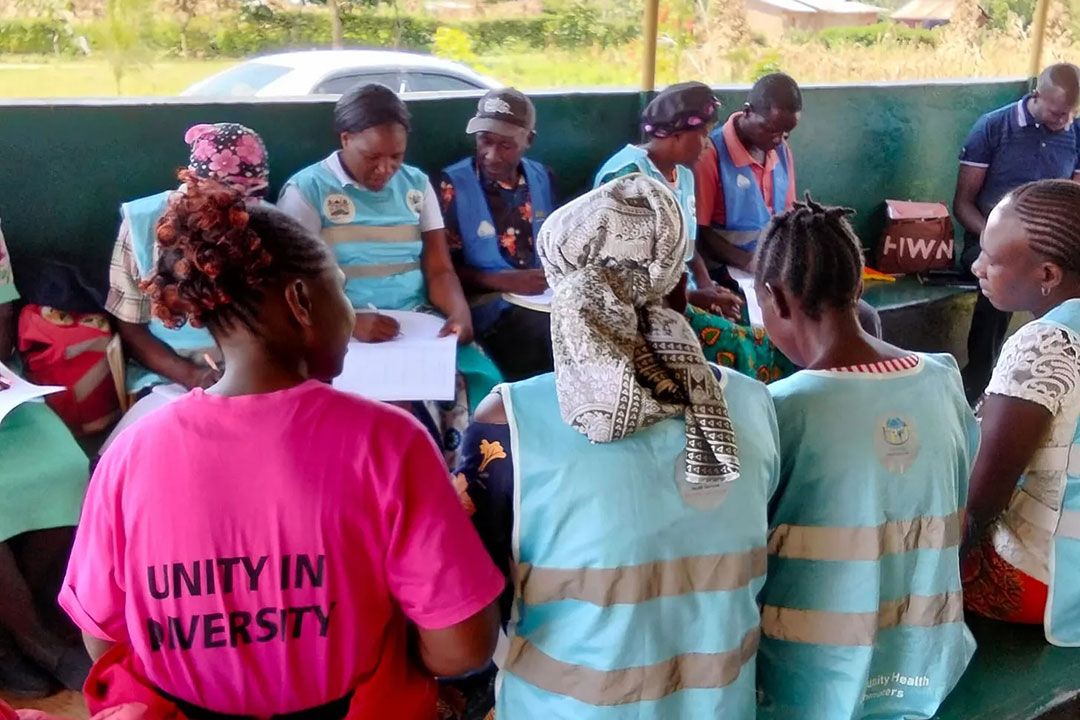
ASHAs and other health workers visit the settlements once or twice a week for immunisation-related activities and to identify newly pregnant women.
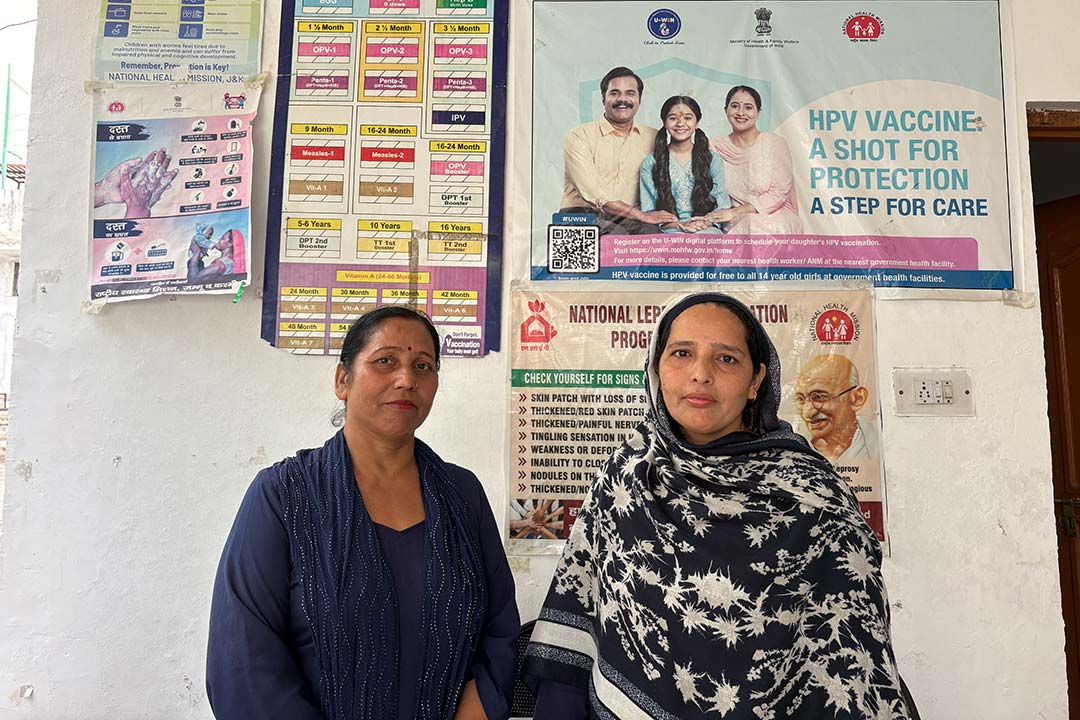
Japneet Kaur, a health worker at a government health centre in Bhitindi, has been making routine visits to Rohingya settlements for years. “Along with the ASHA workers, I visit the camps to meet women and children, check whether any vaccines are pending, and tell families about upcoming vaccinations. Our work is not limited to immunisation; we also raise awareness about family planning,” Japneet told VaccinesWork. “We recently spoke to them about the HPV vaccine also.”
Japneet, who has worked there for seven years, said the centre combines scheduled immunisation sessions with outreach for families who cannot attend in person.
Credit: Raihana Maqbool
“Every Monday, we hold an essential newborn care session here, and on Wednesdays we provide immunisation services. On Thursdays, we visit the settlements and check on people who could not come to the centre. If a woman has a newborn and cannot bring the baby here, we visit her. We also organise medical camps for Rohingya families, and all services are free,” she said.
Families are issued a Mother and Child Protection Card and their details are uploaded to India’s nationwide immunisation app, U-WIN. “Three ASHA workers help staff locate registered families, as many women in the settlements do not have mobile phones.”
Rasheeda Bibi, an ASHA worker in Bhitindi, said outreach visits had helped families understand immunisation and other health services. “On Thursdays we visit the slum areas, including the Rohingya settlements. Apart from vaccination, we raise awareness about family planning, including methods and medicines people can use to space pregnancies. We also conduct awareness campaigns about polio and other vaccines, and go door to door to reach families whose children have missed their polio drops,” she said.
Bibi said regular outreach visits have helped build trust among Rohingya families and address initial hesitation about vaccination. “There was some hesitancy earlier, but now there is much less. Initially, it was difficult to explain the importance of immunisation, but it has become easier,” Bibi told VaccinesWork.
Displacement threatens continuity of care
But the recent evictions – which followed notices from the authorities – have prompting many families to leave the settlements and move into rented accommodation in different parts of Jammu.
For health workers, the dispersal of these communities presents a new challenge.
“Many Rohingya families come to this centre because most of the slums where they live are in this vicinity,” says Garo Devi, an ASHA worker at the Bhitindi health centre.
The challenge now is to figure out how not to lose contact with these families. Although vaccination records can help identify doses that are due, locating families without reliable phone access may require renewed door-to-door outreach.
Masooda Begum, 31, has six children and has lived in Jammu for the past 20 years. She came to the region with her parents when she was a teenager, fleeing Myanmar following the killing of her relatives.
Since then, her family has repeatedly moved between jhuggis and other places. Her husband died last year, and she is getting ready to move again.
“I took my children to the health centre in Bhitindi to get them immunised, and sometimes the health workers would come here,” Masooda told VaccinesWork. “ASHA workers visit this jhuggi twice or thrice a month and tell us when our children need to be vaccinated.”
“The health authorities have always supported us,” she said.