
Rural health monitors wield digital handheld devices to help close Eswatini’s immunisation gap
The remote hill regions of the tiny kingdom are home to ‘invisible’ children – children who have historically gone missing from the country’s immunisation ledgers. But better tools are helping change that.
- 20 July 2026
- 6 min read
- by Zimkhitha Mbulawa
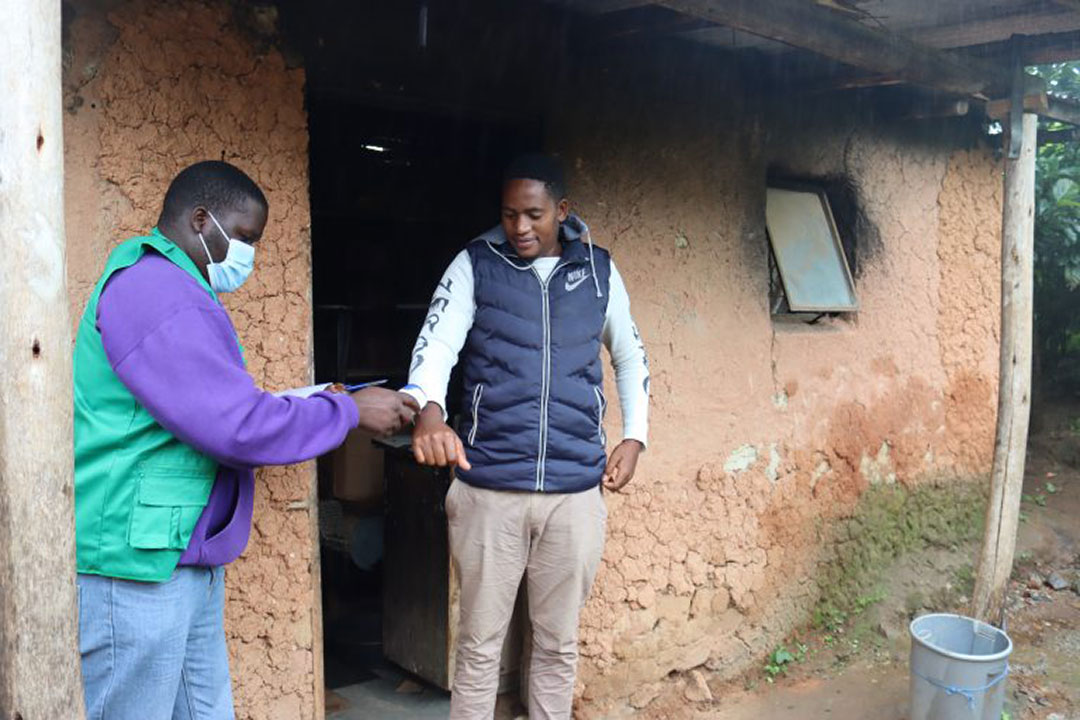
Morning dew carpets the rugged hills of the Shiselweni region in southern Eswatini, as Zanele Mbatha begins to stroll from homestead to homestead.
She has been a Rural Health Motivator (RHM) – a community health worker – here for seven years. This is one of the poorest parts of the country, with more than 65% of households living hard off subsistence farming.
Eswatini’s army of RHMs is vital to health delivery in the tiny kingdom, since 75% of the 1.2 million-strong population live in rural regions. “People like us are usually the only bridge between a family and a proper doctor,” Mbatha explains.
It’s tiring work, but a little less tiring today than it used to be. For years, Mbatha hauled a leather-and-canvas shoulder bag as she walked the steep hill paths. Stuffed with paper ledgers documenting every childbirth, fever, persistent cough, bout of unusual diarrhoea and critical vaccine dose, the bag was heavy.
It was also insecure. Heavy rains could soak and destroy the paper records in an instant, she recalls, dabbing her fingers on the screen of the handheld device that has changed everything.
She types in the clinical and biographical information of every child she visits – skin condition, temperature, eyes health, every immunisation given and its date. “It’s easier now, enjoyable,” she says.
“Invisible” children
Mbatha and her fellow community health workers are unsung heroes on the frontlines of global health security. They are bringing the millions of unimmunised and under-immunised children across sub-Saharan Africa into care and reducing, with every child protected, the risk of large-scale disease outbreaks.
Eswatini’s progress on vaccination over the last several years has been somewhat wavering, with the latest annual World Health Organization and UNICEF immunisation statistics showing 84% of eligible children protected with the first dose of the basic diphtheria, pertussis and tetanus-containing vaccine, a conventional indicator for vaccination coverage in general.
Meanwhile, the 2021–2022 Eswatini Multiple Indicator Cluster Survey showed 77% of 12- to 23-month-old children had received all their recommended vaccines, while just 66% in the 23- to 35-month age bracket had done the same.
“There’s a critical missing gap: the ‘invisible’ children living in remote rural areas cut off from critical immunisations and emergency healthcare because medics can’t cross punishing hills, menacing rivers, rocky ravines and [because of a] lack of reliable cellular phone networks to reach them or establish base,” says Sister Beulah Nokwande, an immunisation nurse at Hlatikhulu Government Hospital, the referral hospital in Shiselweni. Nokwande works closely with RHMs like Mbatha, exchanging insights on progress and challenges in remote communities.
Better tools mean more room for manoeuvre
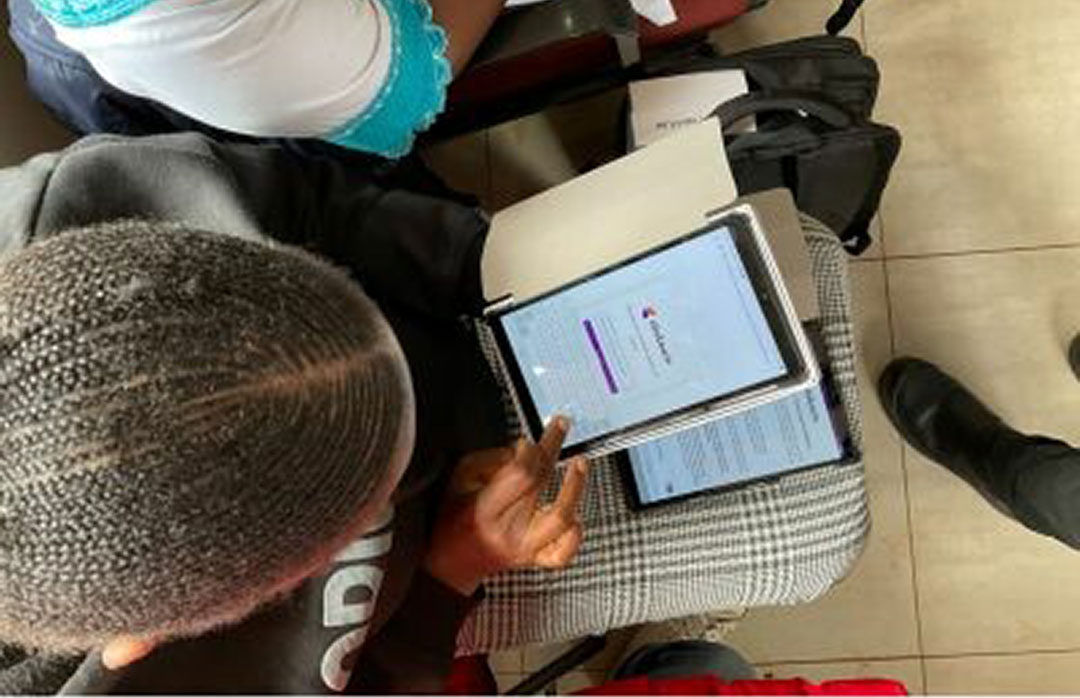
In 2025, to support the work of RHMs, the Eswatini Health Ministry and nonprofit partners launched the Community-Based Health Information System (CBHIS), a digital health data initiative that put efficient devices into the hands of workers like Mbatha.
Credit: Eswatini MOH
“I would say it’s not a new system per se,” says Patrick Shabangu, Technical Director at the Institute for Health Measurement (IHM) Southern Africa, a regional healthcare programming nonprofit that helped the Eswatini Ministry to Health to launch the CBHIS strategy. Instead, Shabangu says, it’s a system that’s been evolving since 2012. That year, IHM began working with the Ministry to develop a hybrid strategy that pulled data from paper ledgers into desktop computers.
“However, the need from the government to make it portable resulted in the RHMs and their handheld devices now. And then [the Ministry] requested for funds from the World Bank,” he says. That funding kicked in in 2023, with IHM taking a leading role in implementation.
Both new and old RHMs were onboarded into the mobile digital health strategy, Shabangu explains, and kinds of data, including vaccination status, began to flow into a central health database known as the Client Management Information System.
Centralisation of real-time information made it possible to cut response times down. “Clients could be quickly referred to hospital facilities to see a doctor once it was determined that their babies had skipped or delayed critical vaccines – or defaulted on ARVs [anti-retrovirals, for HIV treatment], life-saving meds,” he says.
Online or offline
The CBHIS application’s greatest attraction is its versatility, says Mbatha, referring to the devices’ ability to function offline.
In the remote encampments of Shiselweni, mobile cellular phone signals are weak, accessible only from some elevated hilltops. The devices transform into on-site mobile data centres of sorts, she says.
“I don’t need a 2G, 3G or 4G signal to do my work. I can input a newborn’s vaccines data onto the device, collate family structure, log in biodata about last clinic visits and symptoms – all without a cellular signal,” she says.
Afterwards, RHMs like her walk to a summit of a local hill to grab patchy signal from a cell phone tower far away. When even a weak 2G signal is detected, the data on the handheld devices is synced to Eswatini’s national digital medical records database.
Relief for mothers
The RHM’s handheld devices clear big headaches for poor rural mothers who live in the remotest regions of Shiselweni. One of them isMalwande Duma, 37, a mumof twin two-year-old boys. Duma is one of many women here who have relocated their children to regional towns and back, following their husbands’ search for work.
“In thepast, immunisationdata formy kidswould remainhidden inthe villageson paperand inkrecords. Cityclinic nurseswould beconfused, wantingto knowwhich vaccinesspecifically mykids got. They wouldre-dosome vaccines, ‘overdoing’ itor totallymissing others,” she says.
Today, mums like her are happy. The vaccination IDs of their rural children are easily displayed on the computer of any Eswatini computer in a public clinic registry because the RHMs uploaded rural kids’ data onto the country’s e-Impilo medical database.
The digital medical IDs created by the handheld devices interfacing with the country’s central health database does more than simply ensuring that kids don’t miss critical vaccines, says Khanyakwezwe Mabuza, the PrincipalSecretary in the Ministry of Health.
“The whole digitisation creates a legal status for kids’ health – footprints in the national health pathway so that no kids are left behind, be they in the city or far-off villages,” Mabuza says.
The CBHIS programme helps to optimise planning – the government doesn’t have to allocate resources blindly. For example, officials at the health ministry can simply log in and fetch the real-time stats to calculate exactly how many kids in a certain district need supplementary nutrition at public school. “Now that’s empowering,” Mabuza says.
Back in Shiselweni, Mbatha carefully slots her device into a waterproof pouch and gazes down at the villages she will pass through on her way back down.
“Top?” she asks, rhetorically. “That’s where we are already as a country. The critical task ahead is to make sure we collect, refine our healthcare data as a country, and continue to have sovereignty over it,” she says.