
For Delhi’s outdoor workers, every heatwave has a price
On the frontlines of the climate crisis, street vendors and other outdoor workers in the Indian capital find both their health and their livelihoods at risk
- 13 August 2026
- 6 min read
- by Safina Nabi
At a glance
- This summer, parts of Delhi have recorded ‘feels-like’ temperatures of over 51°C. For the millions of the city’s residents who work outdoors, those temperatures are a serious threat.
- For many, financial need all but forbids staying home – and in any case, home often offers little respite from the heat.
- Researchers point out that extreme heat is a health-risk multiplier, hitting the vulnerable the hardest. Poverty, already associated with poorer health outcomes, deepens in temperatures that arrest trade, and a bout of heat-related sickness can spell financial disaster.
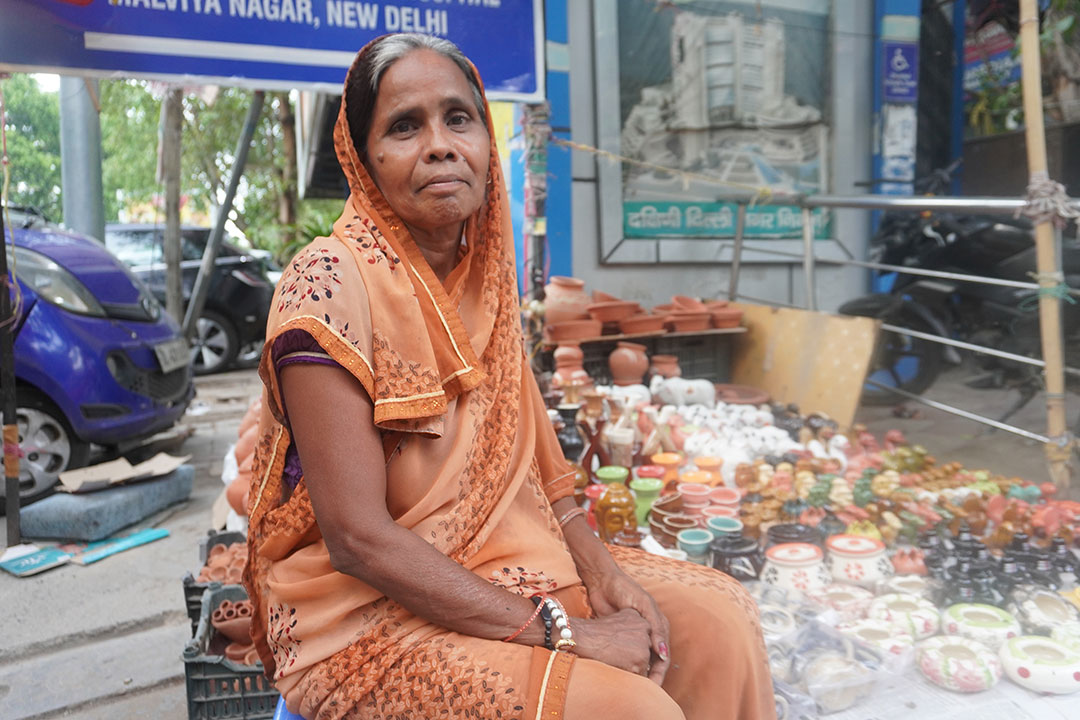
“The heat hits me directly. There is no shade, no fan, not even water,” says 60-year-old Kamlesh Devi, who spends 12 hours a day at her makeshift roadside stall in Delhi. “Sometimes I fall sick and can’t work. Then there is no income, and whatever little emergency savings I have end up going towards doctors and medical tests.”
Every morning by 09:00, Kamlesh travels from Gurugram to Malviya Nagar, where she sells piggy banks, gift items, kitchenware and decorative pieces in the open. A mother of four married daughters, she has made that journey for years. But as Delhi’s summers become hotter and more humid, the work that once sustained her has become increasingly difficult.
This summer, the heat pushed her body beyond its limits. She fainted three times while at work. “The shopkeepers nearby picked me up,” she recalls. At a nearby government hospital, doctors said she was dehydrated and that her blood pressure had spiked dangerously on two occasions.
Credit: Safina Nabi
Kamlesh’s experience is far from unique, unfolding against the backdrop of one of Delhi’s hottest summers. In April, the India Meteorological Department (IMD) issued heatwave warnings across all districts of the capital, forecasting temperatures of 42–44°C – around 6°C above normal for the time of year. In May, Safdarjung, in the city’s south, recorded a maximum temperature of 43.6°C and the city’s warmest night in 14 years. In late June, high humidity pushed the ‘feels-like’ temperature to 51.3°C, making prolonged outdoor work even more hazardous.
Yet staying home is fraught. On a good day, Kamlesh makes sales worth 500 to 1,000 rupees (about US$ 6–12), earning a profit of around 300 to 350 rupees (US$ 3.50–4). At this income level, it’s hard to save up a financial cushion to provide for days off. And lately, her earnings have begun to slip. “There are days when the heat and humidity are so terrible that no one comes to my stall. Even after sitting here all day, I go home empty-handed,” she says. “Sometimes I pack up because I start feeling nauseous. Other days, I don’t come at all.”
A health-risk multiplier
For thousands of people who earn a living outdoors, extreme heat is no longer merely making work more uncomfortable, it is reshaping their health, livelihoods and daily routines. Workers describe skipping meals because they lose their appetite, cutting their working hours, watching customers disappear during the hottest parts of the day and returning home exhausted, only to find little relief from the heat.
In a 2026 study, the International Institute for Environment and Development (IIED) described extreme heat as a “risk multiplier”, amplifying existing inequalities rather than affecting everyone equally. For informal workers, the consequences extend beyond the workplace. Low incomes, insecure housing, limited savings and poor access to healthcare combine to create a cycle in which illness reduces earnings, medical expenses deplete household resources, and recovery becomes increasingly difficult.
Have you read?
Kamlesh’s experience reflects a broader national trend. The 2025 Lancet Countdown on Health and Climate Change found that Indians experienced an average of 19.8 heatwave days in 2024, with 6.6 of those days attributable to climate change. The report also estimated that heat exposure resulted in the loss of 247 billion potential labour hours in 2024; a record high, equivalent to about 419 hours per person and 124% higher than the 1990–1999 average.
The burden fell disproportionately on people whose livelihoods depend on working outdoors. Agriculture accounted for 66% of the labour-hour losses, while construction made up another 20%, highlighting the growing toll of extreme heat on outdoor workers. The associated loss in potential income was estimated at US$ 194 billion.
In response, Delhi’s Heat Action Plan includes public advisories, early warnings and measures to reduce heat exposure. Yet for many informal workers, earning a daily wage still means remaining outdoors despite dangerous temperatures, with limited access to shade, drinking water or cooling facilities.
Unendurable summers
Kamlesh’s struggle is echoed on pavements and street corners across the city, where workers exposed to the elements describe a summer that is becoming increasingly difficult to endure.
Among them is Abrar Ahmad, a fruit vendor.
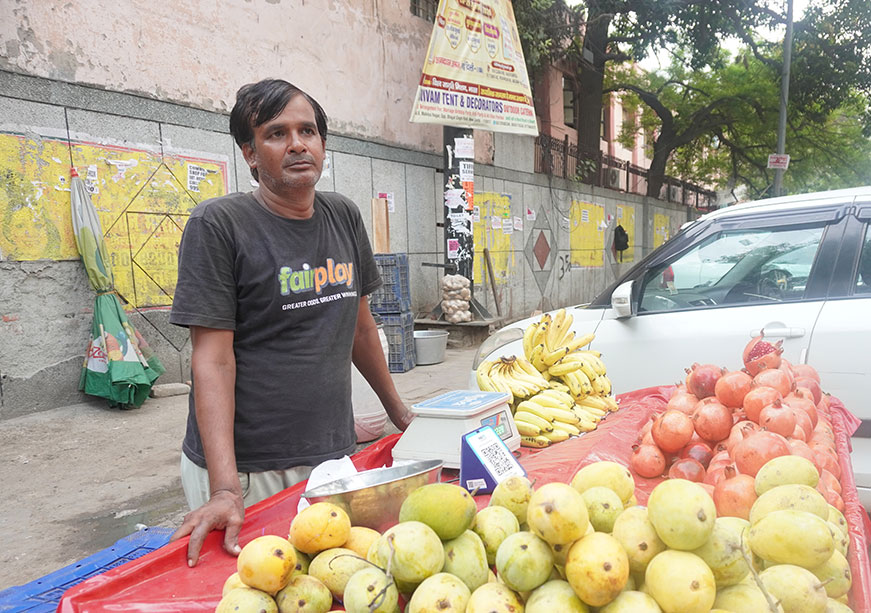
“We dry up in the sun all day, and by evening I have to figure out whether I have made a profit or a loss,” says Abrar Ahmad, a fruit vendor who has lived in South Delhi for nearly 30 years after migrating from Badaun in Uttar Pradesh.
Each morning, Abrar pushes his handcart through the streets, selling seasonal fruits under the open sky. He says the heat is taking a growing toll, not only on his health but also on the fruit he depends on for his livelihood.
“The heat is gruesome. Sometimes the fruits spoil before I can sell them, and that means a loss,” he says.
At home, there is little respite. Abrar lives with his wife and two daughters, a four-year-old and a three-month-old, in a single rented room with a small attached kitchen and bathroom.
“When I fall sick, I can’t work. But when my wife or children get sick, my work suffers then too,” he says. “We all live in one small room without ventilation. This is what we can afford.”
Medicine meets meteorology
Public health physician and policy expert Dr Chandrakant Lahariya says stories like Kamlesh’s and Abrar’s demonstrate why extreme heat should no longer be viewed solely as a weather event.
“Heat affects people in multiple ways. The most immediate impact is dehydration, which can lead to heatstroke if left untreated. Extreme heat also has broader social consequences, reducing energy levels and productivity, particularly among outdoor workers. Many of them also lack access to safe drinking water, increasing the risk of dehydration and electrolyte imbalance,” he says.
“From a public health perspective, protecting outdoor workers from heat is now an urgent priority. Governments should establish cooling points with access to clean drinking water and oral rehydration solutions, and create shaded rest shelters where workers can recover from heat exposure, much like the winter shelters set up during the colder months,” Lahariya added.
As climate change drives hotter and longer summers, protecting those who spend their working lives outdoors may become one of India’s defining public health and labour challenges. For millions who cannot afford to stay indoors, the cost of a hotter city is both financial and physical. It risks becoming existential.