
Eswatini’s traditional healers are now first responders for immunisation
Eighty percent of people in Eswatini see traditional healers first. Mahlala Enginini is one of them, and she’s making sure to funnel them to vaccination centres.
- 1 June 2026
- 6 min read
- by Nokukhanya Musi–Aimienoho
At a glance
- In a country where the vast majority of people seek out traditional healers before trained medical providers, people like Mahlala Enginini are a powerful ally to the immunisation system
- The healer is one of 107 to have been trained up as a “bridge” to the conventional public health system. In addition to throwing bones to consult ancestors and lighting herbs with purifying powers, she now checks for fevers and consults vaccination records.
- It’s a role she’s glad to perform. “I’ve seen families do lose their children too many times,” she told VaccinesWork.
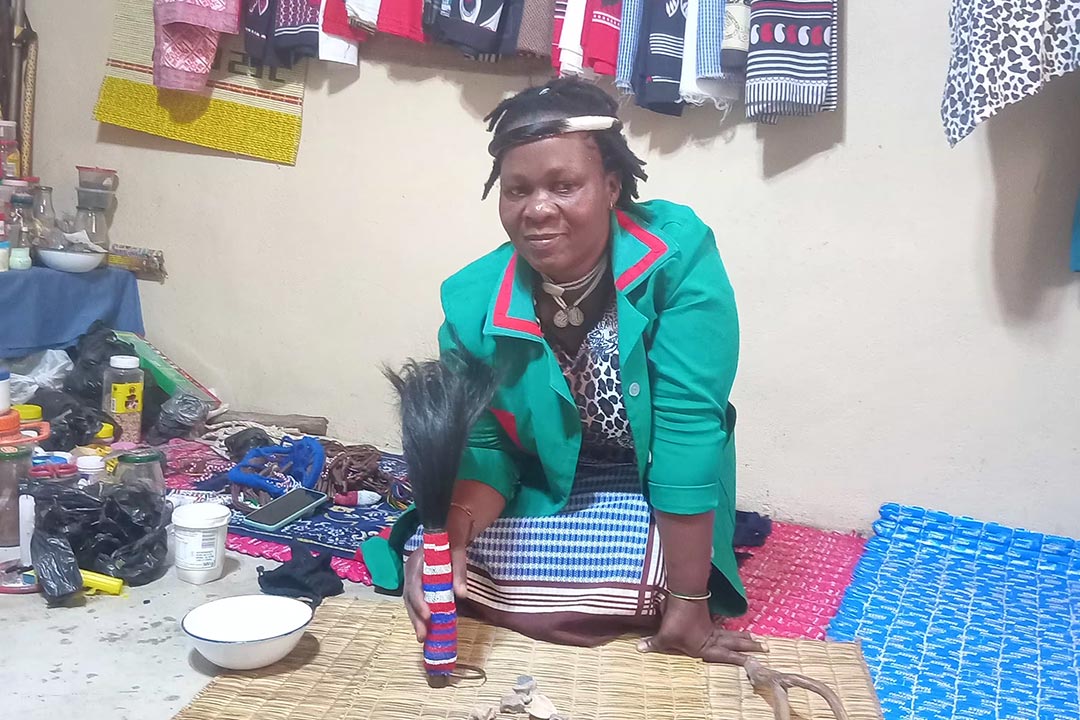
The distant crowing of the cockrel can be heard in the bustling informal settlement of New Village in Eswatini, as 52-year-old traditional healer Gertrude Ginindza kneels down on a grass mat to burn impepho, the Helichrysum herb.
Smoke fills the hut, which is stacked high in every corner with tins and containers: some rusted, some plastic, all filled with ground roots, dried leaves, bark and varying concoctions.
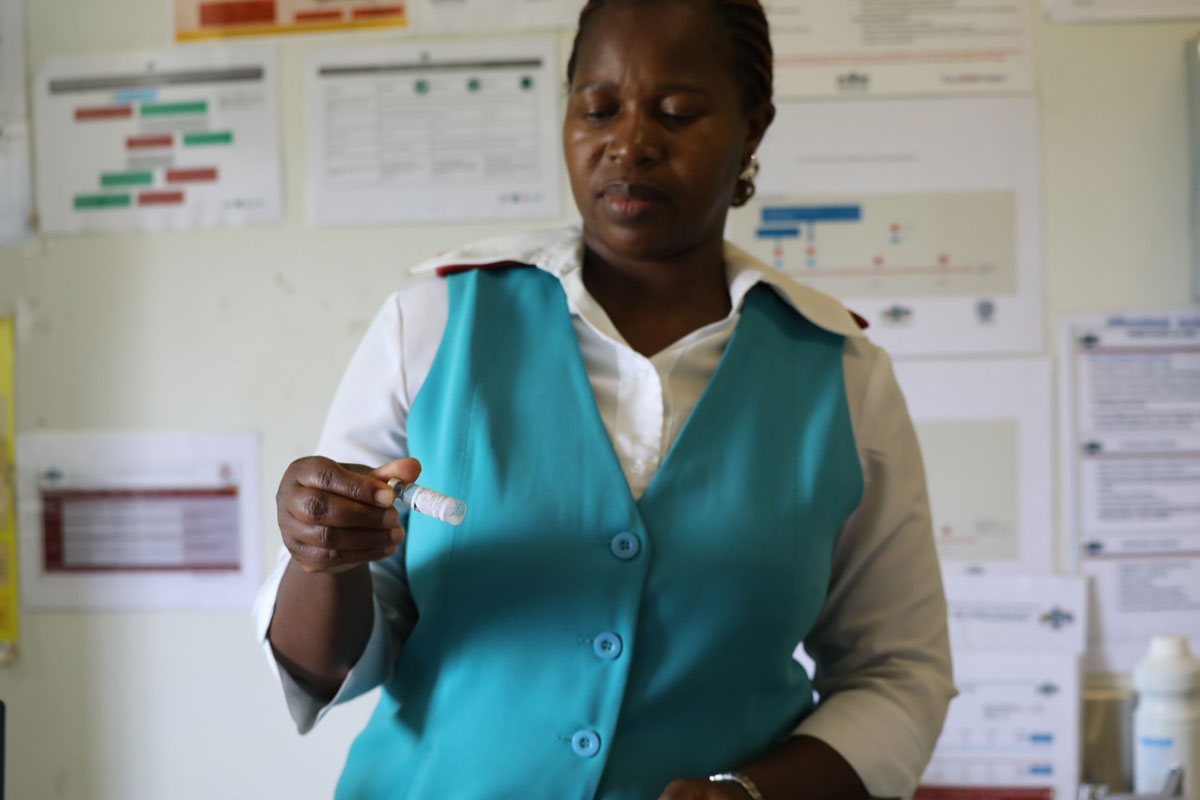
As an immunisation champion, Mahlala Enginini now checks on more than the spirits. She checks health cards for missed doses, foreheads for fever, chests for rattles, arms for BCG scars and more.
This is a typical morning for Ginindza, known in her community as Mahlala Enginini – a name given to her by the ancestors – as she readies herself to receive the first patients of the day. It’ll be a long time yet before the gates at the nearest clinic in Sidvokodvo open.
Most mornings, the majority of her patients are mothers and grandmothers who come with young children for ritual steaming and spiritual cleansing.
However, since last year, her consultations have taken on another purpose.
Bringing the clinic to the rondavel
Mahlala Enginini is one of 107 traditional healers from across Eswatini’s four regions to have been trained up by the Ministry’s Expanded Programme on Immunization (EPI) to help strengthen vaccine uptake. She now plays a critical role, bridging the gap between families and healthcare facilities – a responsibility she takes seriously.
"When was the child last vaccinated?" Mahlala Enginini asks. It is the most important question, one that crosses the divide from the hut to the clinic, from tradition to modern medicine.
In the tiny Southern African nation, some 45% of all children are classified as orphaned or vulnerable, according to UNICEF’s 2023 Situation Analysis. 84% of children have received all three doses of the basic diphtheria, tetanus and pertussis-containing vaccine, while 85% have received the first of two recommended doses of measles vaccines, per WHO/UNICEF estimates.
As an immunisation champion, Mahlala Enginini now checks on more than the spirits. She checks health cards for missed doses, foreheads for fever, chests for rattles, arms for BCG scars and more.
She doesn’t replace the clinic, but carries it into the huts. Trust follows her: 80% of the 1.2 million Emaswati consult traditional healers first.
Wrapped in a traditional Swazi kanga, 62-year-old grandmother Rose Ntombifuthi Dlamini brings her five-year-old grandson Semusa Makhanya to Mahlala Enginini’s hut.
Greetings are exchanged, and the grandmother proceeds to tell her why they have come.
Have you read?
Thereafter, the boy is laid on a woven mat, and the healer approaches to take a look at him.
Usually, she throws the bones to consult with the ancestors but instead, she puts her right hand on his forehead and listens to his chest. She raises his shirt to see whether he has a rash.
“When was the child last vaccinated?” Mahlala Enginini asks. It is the most important question, one that crosses the divide from the hut to the clinic, from tradition to modern medicine.
“You will need to take the boy to the clinic today,” she says, as she rips off a piece of paper and notes down details such as the name of the boy, age, symptoms and vaccinations that are due.
Dlamini takes the piece of paper and the card, thanks Mahlala Enginini and leaves, together with her grandson.
Too much loss
Mahlala Enginini says that while her formal training taught the clinical side of vaccines and vaccine-preventable diseases, she learned the importance of immunisation here – in her healing practice, and in motherhood.
She received her calling in 2014, and sees around 30 patients a month in her New Village hut.
“One-on-one sessions with my patients allow me to fully understand my patients’ conditions and also, the problems in accessing the help they need,” she explains. “Some of my patients have been seeing me for years, which has fostered trust.”
That changes how her advice is received.
According to her, the stakes are high because if no one asks about vaccines, those children don’t make it to the clinic.
“The training helped me realise that without early vaccines, a baby can be left disabled or even experience worse complications,” she says.
She recalls cases of families who only relied on traditional remedies and skipped the first shots for their infants. “It would start with a fever and a cough. I’ve seen many families lose their children too many times,” she says.
A parent’s grief is something she understands: Mahlala Enginini is a mother of eleven, one deceased.
Reinforcing the referral system
In a bid to protect families from losses like those, the government launched the National Immunisation Strategy for 2026–2030, alongside a Social and Behaviour Change Strategy and Effective Vaccine Management standard operating protocols. EPI Communications Officer Zodwa Dlamini says part of that plan is bringing healers into the surveillance loop.
“Healers were trained to always ask if the child attends immunisation and confirm if the child’s health card is available. They were requested to spread the message that vaccines are safe, effective and lifesaving; immunisation is essential from pregnancy. They were also given strict instructions not to put substances on the injection site after vaccination and to refer suspected VPD cases or unvaccinated children to the clinic immediately,” she explains.
EPI Programme Manager Xolisiwe Dlamini admits that although this initiative is bridging a critical gap, it still needs work.
“The Traditional Healers Association wants structure. They’ve asked the Ministry of Health to develop SOPs for referrals both ways – from healers to facilities, and back again. They also want a proper feedback system, so healers know what happened to the cases they refer. And where the team suspects a case isn’t medical but might be traditional or spiritual, they want that communicated openly,” she notes.
Mahlala Enginini agrees, adding that they need an office for healers, and equiment – gloves, screening tools, thermometers, a dosage guide among other tools and equipment.
Although Xolisiwe Dlamini and Mahlala Enginini point to what’s still missing, the Health Ministry's Communications Officer Nsindiso Tsabedze says the structure is already taking shape.
According to Tsabedze, traditional healers are now embedded in a wider network – working with the Health Promotion Unit, Schools Health Programme, clinic health workers and Community Based Health Services Volunteers.
“All of them engage communities on vaccination, and healers play a critical role in strengthening national immunisation efforts,” he says.
What might have seemed an unlikely partnership between traditional healers, formally trained health workers and the Ministry is shaping up to be one of Eswatini’s strongest lines of defence against vaccine-preventable disease. By meeting communities where they first seek care, this partnership is catching children earlier and turning missed opportunities into moments of prevention.