
The games ‘inoculating’ us against health misinformation
Scientists are showing how exposing people to manipulative techniques through games can act as a ‘psychological vaccine’ against bad health information.
- 6 February 2026
- 3 min read
- by Priya Joi
At a glance
- Exposing people to ‘weakened doses’ of misinformation can act as a ‘psychological vaccine’ against bad health information.
- Online games such as Cranky Uncle Vaccine and BadVaxx uses this idea to teach players to spot tricks such as cherry‑picked data, fake experts and emotional manipulation.
- Early studies suggest that playing these games can shift 50% or more of people from vaccine hesitancy towards confidence in vaccination.
Scientists are testing a new tactic in the battle against health misinformation: games that can act as a ‘psychological vaccine’.
Just as we use vaccines to send antigens into our body to produce an immune response, psychological ‘antigens’ or pieces of misinformation shown carefully can help build resistance to fake news.
And research suggests that it could be an effective method of moving the needle on vaccine hesitancy.
Game on
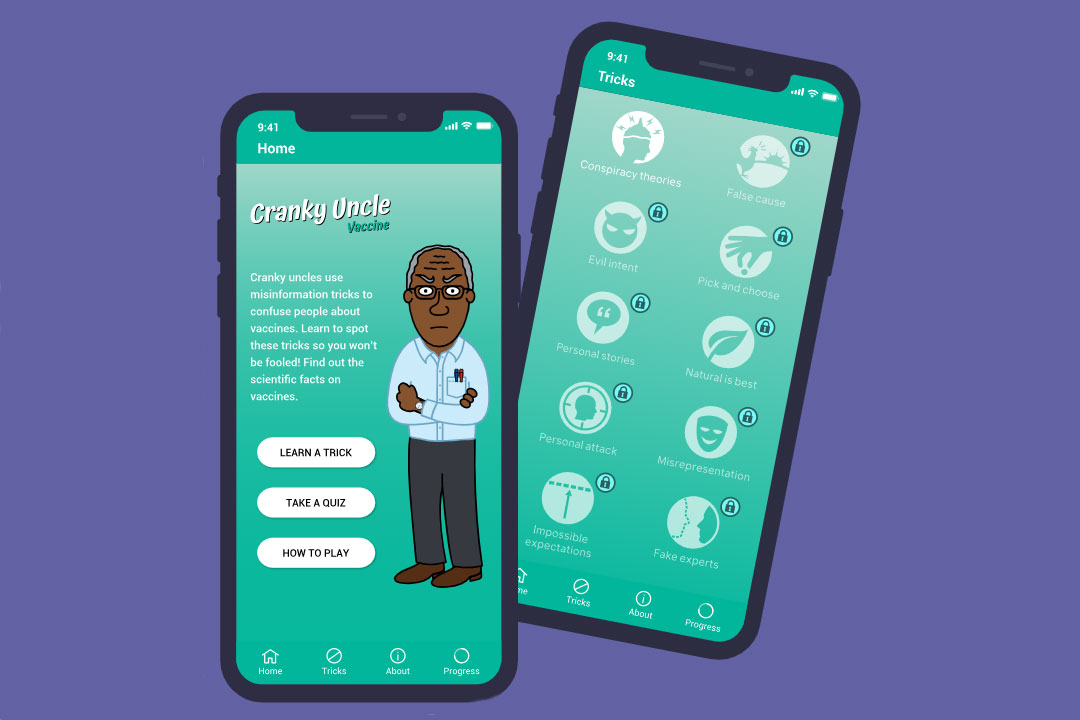
John Cook, a Senior Research Fellow with the Melbourne Centre for Behaviour Change at the University of Melbourne, has been piloting ‘Cranky Uncle Vaccine’, a game designed to help people spot facts from fake news, helping to increase vaccine acceptance in Ghana, Kenya, Pakistan, Rwanda, Tanzania and Uganda.
In Cranky Uncle Vaccine, players take on the role of a misinformer to learn how fake news spreads. Cook likens the game to pulling back the curtain on a magician’s tricks: once people know how they’re being manipulated, they are far less likely to be taken in.
In Cranky Uncle Vaccine, players take on the role of a misinformer to learn how fake news spreads. Cook likens the game to pulling back the curtain on a magician’s tricks: once people know how they’re being manipulated, they are far less likely to be taken in.
The UNICEF-funded pilot studies invites players to employ the manipulative techniques that some sources use – cherry-picking data, using fake experts or having impossible expectations of science (such as expecting a vaccine to be 100% effective).
An accompanying study suggests that in general half or more participants switched from being vaccine-hesitant before the game to being in favour of vaccines after playing the game.
While these games can be effective at changing people’s minds, both Cook and and Sander van der Linden, professor of Social Psychology in Society, University of Cambridge, UK say that ‘prebunking’ – inoculating people to be protected from misinformation – is as important as debunking.
BadVaxx
Van der Linden and colleagues have developed BadVaxx, a “social media simulation that exposes users to humorous weakened doses of some of the key strategies used by online grifters to manipulate people’s attitudes toward vaccination.”
Have you read?
The game asks players to choose to be a villain or a hero before revealing how people can manipulate truths on social media to gain engagement and followers, use medical credentials to push pseudoscience or use the idea of a ‘natural’ or ‘organic’ lifestyle to demonise vaccines.
Even playing the “hero” version of the game helps people detect manipulative information and the quality of information shared, according to their 2025 Nature paper.
“Along with the UK government and the World Health Organization, we were able to reach 200 million people during the pandemic as part of the ‘stop the spread’ campaign whose aim was to flatten the curve of misinformation,” says van der Linden.
Both Cook and Sander van der Linden are optimisic about gamification approaches to fight misinformation. “People can actually pass on the cognitive vaccine vicariously to their friends and family,” says van der Linden.
“The psychological vaccine can travel across networks. That gives me hope that we can immunise each other against falsehoods,” he says.