
Vaccine myth-busting takes centre stage in southern Mali
In hard-to-reach parts of southern Mali, the performing arts are emerging as an effective method to address misinformation about immunisation.
- 6 July 2026
- 8 min read
- by Abdoul Moutalib Ag Watane , Olivier Konan
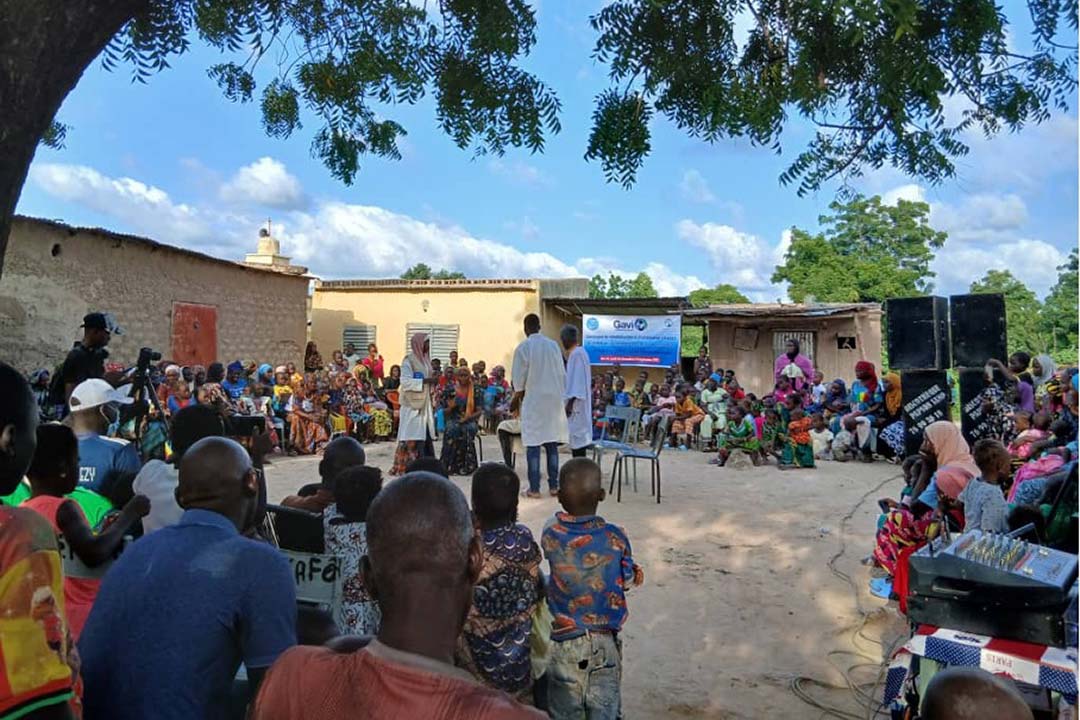
Approximately 170 kilometres east of Mali’s capital, Bamako, in isolated Bananido village in Barouéli health district, bursts of laughter and applause capture the attention of passers-by. Unconventional scenes are being enacted for an audience beneath the large neem tree in the public square.
The performance taking place is not solely a form of local entertainment, however – it is a public health intervention. A travelling theatre group from the civil society organisation Amaan Gourma is acting out a skit on the topic of familial health decisions, with a focus on vaccination.
Rumours proliferate about vaccination in the hard-to-reach communities of Bananido and Nianzana in southern Mali, where Amaan Gourma operates. Nervousness and misinformation about adverse effects, religion-related taboos and persistent myths about vaccine-induced fake sterility all hamper immunisation efforts in the villages where the theatre troupe stages its shows.
Breaking new ground in the Sahel
In November 2024, Mali became the first Gavi-supported fragile and conflict-affected nation to introduce the cervical-cancer blocking human papillomavirus (HPV) vaccine – one of the first countries in the Sahel to achieve this milestone. This decisive breakthrough not only has the potential to protect entire generations of Malian women, but also serves as a model for other countries in the region, contributing to Gavi’s global goal of reaching 120 million girls vaccinated against HPV in low- and middle-income countries by 2030.
However, novelty has made the HPV vaccine, which is recommended for girls between the age of 9 and 14, a particular object of rumour and misconception.
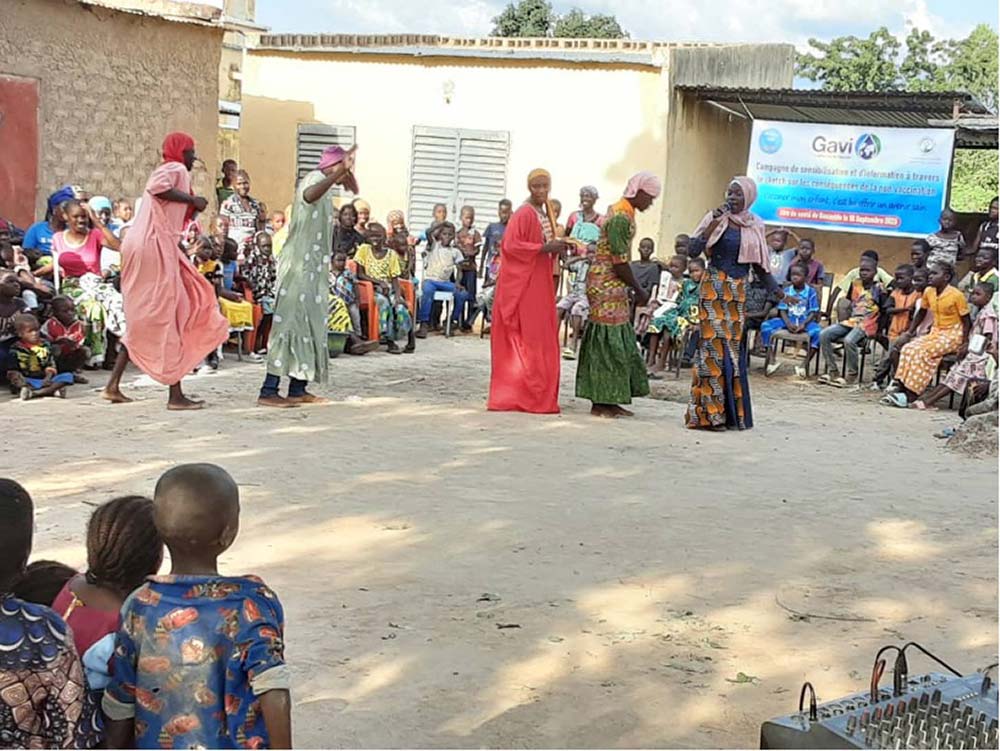
Vaccine refusal and its potentially dire health consequences often follow in the footsteps of circulating misinformation, so Amaan Gourma has adopted a creative and bold methodology of myth-busting through entertainment. Since June 2025, the Malian CSO, supported by Gavi, has been transforming public squares into arenas of interactive information-sharing.
© Amaan Gourma, Mali
A locally embedded approach
Amaan Gourma’s understanding of local practices and hierarchy is central to its success. “The actors are not strangers: the troupe comprises sons and daughters of the community, articulating their messages in local languages such as Bambara, Soninke, or Fulani,” says Abdoul Moutalib Ag Watane, Amaan Gourma’s Programme Coordinator.
Not only are the actors locals themselves, but a chain of trusted community members prepares the ground for each performance. Community health workers seek chieftains’ permission; council members, religious leaders spread the word. Griots – traditional storytellers – go house to house to herald the arrival of the troupe. By the time the stage is set, some 80–90 villagers have assembled to watch.
Public health meets performance
Seydou Ballo, 44 is the director of the local radio station in Barouéli and part-time manager of the theatre troupe programming.
Together with the project team and the cast-mates, Ballo identifies topics to address. Then they build scenarios, with technical guidance supplied by the local Health District Director. Ballo sees his two roles as continuous: “On the radio, I disseminate information vocally. On stage, I communicate through corporeality and emotion.”
More CSO stories
In Amaan Gourma’s three- to five-minute vignettes, comedians and actors perform scenes of parental anxiety, their uncertainties about vaccination amplified by rumours. The risks of non-vaccination create dramatic tension or a sense of guilt for a parent who did not make the right decision regarding their children’s health; the subsequent profound relief of witnessing their children protected ripples through the village square.
The youngest cast member is 22-year-old Fatoumata Sidibe. On stage, she might portray the health focal point, the community liaison, an internally-displaced woman, or the hesitant mother who ultimately revises her perspective on immunisation.
Taking on these recognisable roles enables her to establish trust with her audience, and often, she says, opens the door to authentic exchanges with women. “After the performances, women flock to me. As a young active health agent, they feel more comfortable coming to me and talking to me without fear,” says Sidibe.
Trust through familiarity
Exchanges like these have made it clear to the cast that watching familiar faces using locally and culturally appropriate codes to tackle the issues head-on helps to counter real-world mistrust in hard-to-reach areas such as Bananido or Nianzana.
One single mother, who was visibly moved by a performance in Bananido in the Ségou region, said, “I harboured a fear of vaccines. However, thanks to this troupe, I comprehended that the genuine peril lies in remaining unvaccinated.”
Another audience member, a woman displaced from her home due to attacks by non-state armed groups elsewhere in the region, said: “I was under the impression that the vaccines incurred a cost, and that they were inaccessible to non-residents. Through the theatre, I have come to realise that the vaccine is provided free of charge.”
In September 2025, during an intervention in a village within the Nianzana region, an enthralled audience requested the troupe to perform the same play a second time.
Stories that open conversations
Local health workers say it’s making a difference: Mamadou Diallo, an immunisation agent in the Bananido health area, says that the theatre enhances his efficacy during home visits: “Previously, I was obliged to independently elucidate the importance of the vaccine to each household. Now, following the sketches, individuals approach me with greater ease. It conserves time and, crucially, I perceive a marked reduction in mistrust.”
Integrated communication strategies
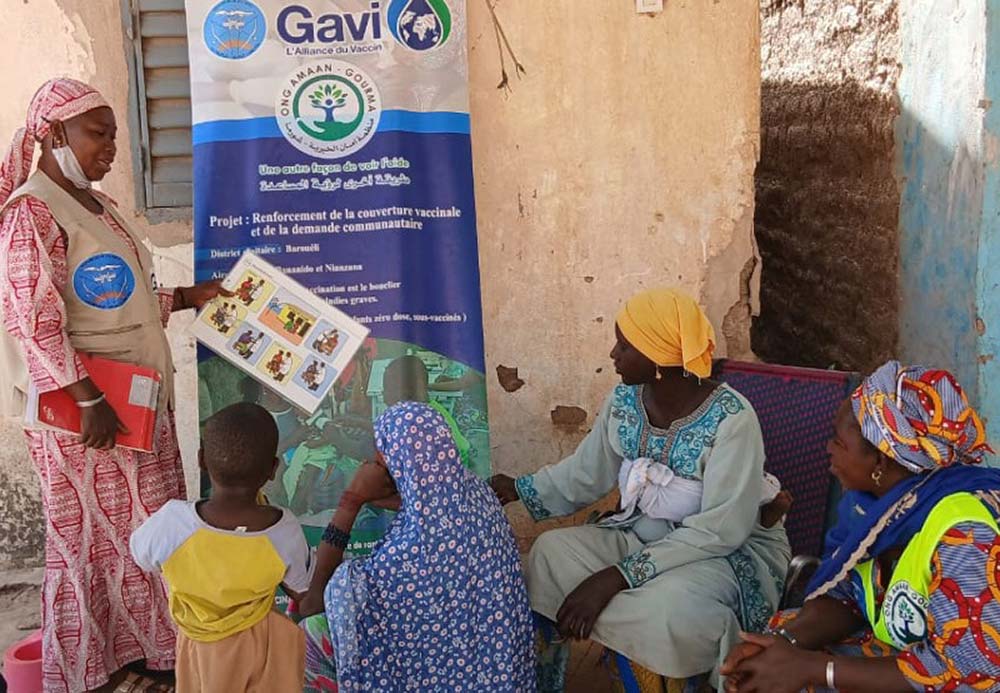
Before each intervention, Amaan Gourma help to raise awareness about vaccination by sharing messages in local languages through ‘credible messengers’.
These are respected figures who are trusted by communities. “They are called ‘credible messengers’ because they are carefully selected and trained to connect the community with health services. They inspire trust because they understand medical information and can explain it in simple language,” explains Abdoul Moutalib Ag Watane, Amaan Gourma’s Programme Coordinator.
Amaan Gourma has deployed five ‘credible messengers’ per health zone. Drawing from the local community, they are selected from women with a variety of backgrounds: housewives, leaders of community organisations, vaccinators appointed by the District Health Office (DTC), or active members of community health associations.
Mariam Diarra, a credible messenger and active member of a Community Health Association in Bananido, is an example of this scheme. She carries out home visits to talk to families, address their concerns and prepare for the arrival of the vaccination teams, particularly in the most hesitant households. She also helps to produce radio adverts and lends her acting skills to sketches designed to reach a wide audience.
The messages they collaboratively create are broadcast six times a day on Barouéli’s local radio station, DANAYA FM, by Seydou Ballo. One avid listener is Barouéli’s chief Bakari Traore, who switches on the Sarakolé-language programming as soon as he wakes up, before joining the Amaan Gourma team for their door-to-door awareness-raising visits.
© Amaan Gourma, Mali
Safe spaces for change
Home visits, like the ones Bakari Traore takes part in, help to maintain an ongoing connection with local communities. Families are educated on the importance of the vaccination schedule and how to manage minor side-effects. Missed-out, under-immunised children are identified on doorsteps, and their names are logged and flagged for vaccination teams during mobile and fixed-point vaccination campaigns.
Fatoumata Diarra, a mother from Boidié (Nianzana Health Zone), says: “Thanks to the visit from the Amaan Gourma team, I realised that my son hadn’t been vaccinated against measles; they took me to the mobile clinic so he could be vaccinated.”
The families visited often express their relief at receiving reliable information at home. There are distances of 15–25 km between farming hamlets and referral health centres.
And the theatre troupe has become a valued part of village life. The cast has performed in Bananido for less than a year, yet “the villagers are already waiting for them to return,” says Seydou Ballo.
For Amaan Gourma, this is the clearest sign that something has shifted: people are keen to talk about vaccination as a common topic of conversation, and the conversation now starts from within.
Reaching every age group, from infants to adolescents
Through its information, education and communication (IEC) activities, Amaan Gourma has succeeded in fostering a genuine commitment among young girls and their communities in support of HPV vaccination. To add to the awareness-raising and demand-generation activities, Amaan Gourma provides logistical support to vaccination teams so they can travel to the most remote areas and reach households that do not have access to vaccination services.
According to the Digital Health Information System (DHIS2), Amaan Gourma’s social mobilisation efforts have resulted in the administration of 1,820 doses of the HPV vaccine to girls between June 2025 and March 2026 in the Barouéli health district.
The project also enabled the sensitisation of almost 2,000 adolescents, mobilised primarily for targeted interventions such as HPV vaccination.
More from Abdoul Moutalib Ag Watane