
The furthest ‘last mile’: how vaccines reach children in Uzbekistan’s most remote areas
A vaccine can travel hundreds of kilometres before reaching a child in Uzbekistan, but its temperature must stay within a tightly controlled range every step of the way.
- 24 August 2026
- 7 min read
- by Umida Maniyazova
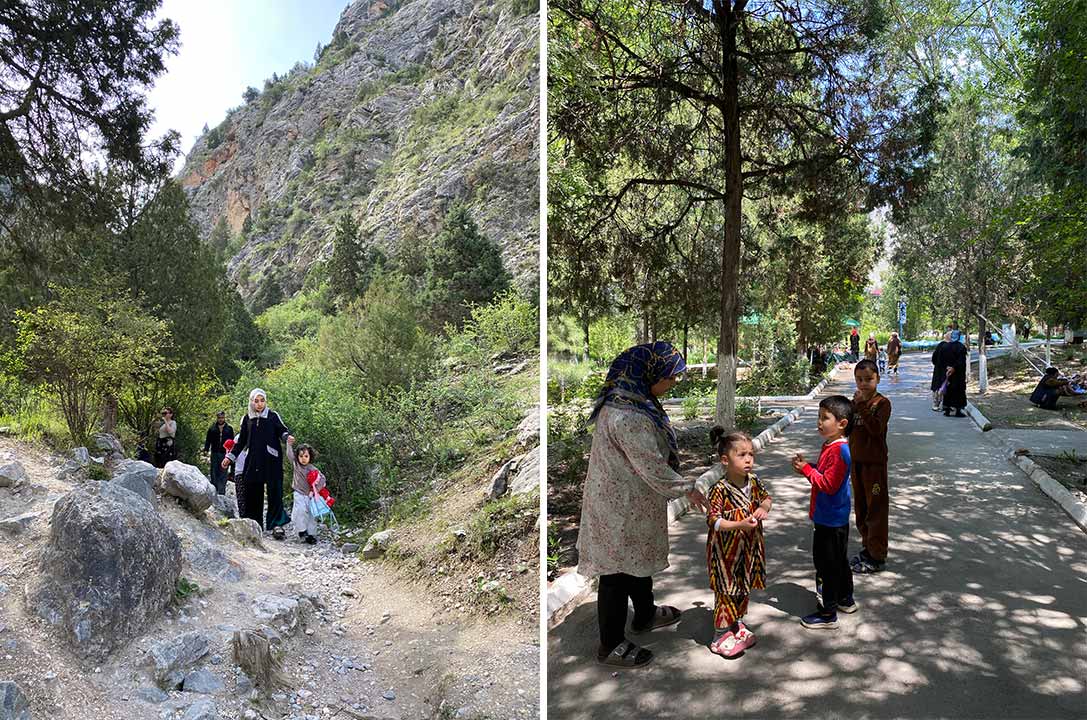
When parents bring their child to a small mountain clinic for routine vaccination, few think about the journey that tiny vial has made.
In Uzbekistan, there’s a guarantee that that journey has been an odyssey, beginning thousands of kilometres away, at a pharmaceutical manufacturing facility, and continuing through an international logistics network before touching down in the hold of a cargo plane in Tashkent. Those vaccines must then travel through the country’s distribution system to reach every region, including remote mountain settlements where only a few dozen or a few hundred families may live.
For a country with vast deserts, high mountains, enclaves and remote villages, ensuring that vaccines reach every child safely is one of the challenges facing the national immunisation system.
The most sophisticated cold-chain infrastructure cannot reach a child without the people working at the final stage. In Shahimardan, this means a rural nurse who may have to travel along difficult mountain roads, protect the vaccines during the journey, check their condition, communicate with parents and finally, vaccinate children.
Thermal jeopardy
Most vaccines must be stored at between 2°C and 8°C, while some require much lower temperatures. This means that from the moment a vaccine arrives in the country until it is administered to a child, it must be kept cool, in a gapless system of mobile and fixed fridges and cooler boxes collectively known as the cold chain.
According to Umid Khudaykulov, Programme Officer at UNICEF Uzbekistan, vaccines arrive in Uzbekistan by air in refrigerated or temperature-controlled containers and are then transported to the Republican Cold Chain Warehouse in Tashkent. At each stage of the journey, the temperature is monitored.
Vaccine vials also carry a Vaccine Vial Monitor (VVM) – a small sticker that changes colour if the vaccine is exposed to excessive heat. It provides an additional check for health workers before a vaccine is administered.
Central Asia’s largest vaccine cold-storage facility
A major change to Uzbekistan’s vaccine logistics came in November 2021, when the Republican Cold Chain Warehouse opened in Tashkent with UNICEF support and was handed over to the Ministry of Health. Since then, the facility has served as the central logistics hub for the country’s immunisation programme.
According to UNICEF, the warehouse has three refrigerated chambers with a combined area of around 1,000 square metres, operating at 2–8°C. It also has freezer and ultra-low-temperature storage facilities, including equipment capable of maintaining temperatures as low as -70°C, as well as space for syringes and other medical supplies.
The facility also has systems designed to maintain the cold chain during loading and unloading, as well as backup power supplies.
Have you read?
“The warehouse operates as a logistics hub for the entire national immunisation programme. All vaccines imported into the country come here and are then distributed to the 14 regional warehouses,” Khudaykulov said.
The centralised system also makes it possible to plan deliveries to hard-to-reach areas in advance, rather than responding only when supplies are needed. According to Khudaykulov, this helps reduce the risk of local shortages and vaccine losses caused by storage or electricity problems.
From the central warehouse to the edge of the map
But no doses end their journey at the central warehouse. Vaccines are distributed from Tashkent to 14 regional cold chain warehouses, including the facility serving the Fergana region, where the village of Shahimardan is located.
From the main Fergana hub, vaccines move through 209 district-level storage points before reaching health facilities and mobile vaccination teams. Transportation between major facilities is carried out using refrigerated vehicles or temperature-controlled containers equipped with cold packs. Temperature loggers are used to monitor conditions during transportation.
The final stage of this journey to remote locales like Shahimardan can be the most difficult. This is what health specialists call the ‘last mile’.
The last mile to Shahimardan
Shahimardan is an Uzbek enclave surrounded by Kyrgyz territory in the Fergana Valley. At an altitude of around 1,550 metres and surrounded by mountains, Shahimardan is a natural logistical puzzle.
As a vaccine destined for a Shahimardan child leaves the district-level storage facility, it leaves the actively refrigerated portion of the cold chain behind, and is entrusted to an insulated vaccine carrier bag with ice packs.
“Insulated containers and vaccine carrier bags with cold packs are standard equipment for mobile teams and rural facilities on the last mile. They are designed to maintain the required temperature throughout the team’s working day,” Khudaykulov explained.
But this final stretch can throw up surprises, making it one of the most vulnerable points in the cold chain. Poor road conditions and long travel times can make it harder to maintain the required temperature inside the vaccine carrier. To strengthen monitoring during transportation, temperature loggers, GPS tracking and additional thermal insulation are increasingly being used.
The road includes mountain sections and winding routes. In winter, snow and ice can make travel even more complicated, while other seasons can bring difficult weather conditions and the risk of mudflows.
“For routes like these, Uzbekistan, together with the World Health Organization and UNICEF, is implementing the ‘Reach Every District’ strategy, designed to reach hard-to-access communities through outreach teams, additional vaccination days and strengthened supervision,” said Khudaykulov.
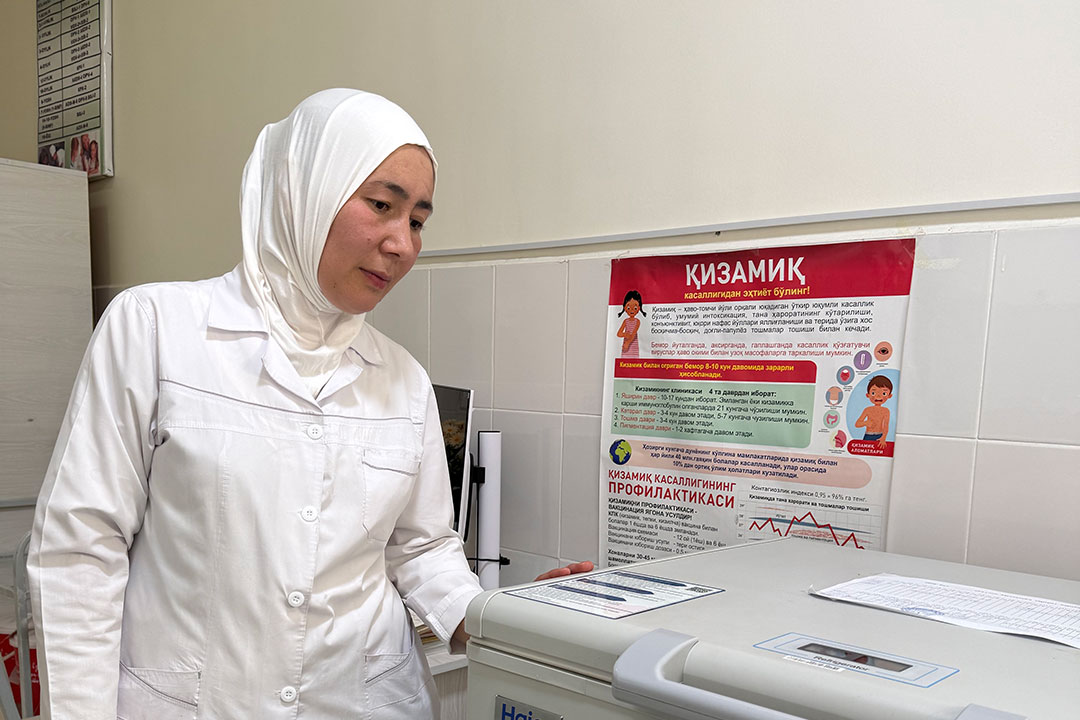
Shokhsanam, a nurse at the local health facility, says that remoteness affects many aspects of everyday life in Shahimardan, but vaccination is treated differently.
“We do not have a bank here, for example, so people have learned to adapt. Some go to Fergana once a week or once a month to deal with banking and other things. But vaccines are different. We cannot tell parents to wait until someone happens to be going to the city. Vaccines are delivered according to the schedule, and we make sure they are available when children are due for them.”
“Even though Shahimardan is remote, vaccination should not depend on how easy it is to get here. A child should receive the vaccine on time, just like a child anywhere else in the country.”
That’s always been true for three-year-old Zilola. Her mother, Kamola Rakhimova, confirms she has never needed to wait for a vaccine to arrive in stock locally. “My relatives in Fergana sometimes cannot believe that Zilola receives her vaccinations on time. They live in the city, yet sometimes they have to reschedule. Here, the nurse tells me in advance when we need to come.”
Rakhimova says that the most important thing for her is knowing when the next vaccination is due and being able to reach a health worker without having to travel outside the enclave.
“When in doubt, do not use it”
But what happens if the cold chain is broken? There is little room for uncertainty when it comes to vaccine storage.
If a temperature indicator shows that a vaccine has been exposed to unacceptable conditions, the affected doses are removed from circulation until their safety and usability can be assessed. “The principle is: when in doubt, do not use it,” Khudaykulov said.
In such cases, the incident is recorded and the relevant temperature data is reviewed. If necessary, the affected vaccines are discarded and replaced from available reserves.
The cause of the problem is also investigated – whether it was a malfunctioning refrigerator, a power outage, a delay on the road or another problem during transportation.
At the finish line, the nurse administering the dose checks the VVM on the vial and goes over the relevant temperature indicators in the vaccine carrier. Only after confirming that the vaccine has remained within the required conditions can it be administered.
The vaccination is then recorded in the Electronic Immunisation Registry (EIR), a digital system used across Uzbekistan’s regions, and the heavily-monitored dose’s journey is officially complete.
Where the system meets the person
Yet even the most sophisticated cold-chain infrastructure cannot reach a child without the people working at the final stage.
In Shahimardan, this means a rural nurse who may have to travel along difficult mountain roads, protect the vaccines during the journey, check their condition, communicate with parents and finally, vaccinate children.
Zilola doesn’t know the backstory of the vaccine dose the nurse draws up into the syringe at her latest immunisation appointment, doesn’t realise how many more kilometres it has had to traverse than the jab administered to a kid in Tashkent, and she doesn’t need to. What matters is that when her mother is told it is time for the next dose, the vaccine is there – still safe, still effective and ready to protect her from preventable diseases.
More from Umida Maniyazova

Recommended for you