
“We’ll all be fine”: COVID-19 vaccines arrive at Korle-Bu Teaching Hospital, Accra
After a difficult year, the vaccination roll-out is underway at Ghana’s premier medical facility, where health workers dare to hope that things can go back to normal.
- 18 March 2021
- 5 min read
- by Maya Prabhu
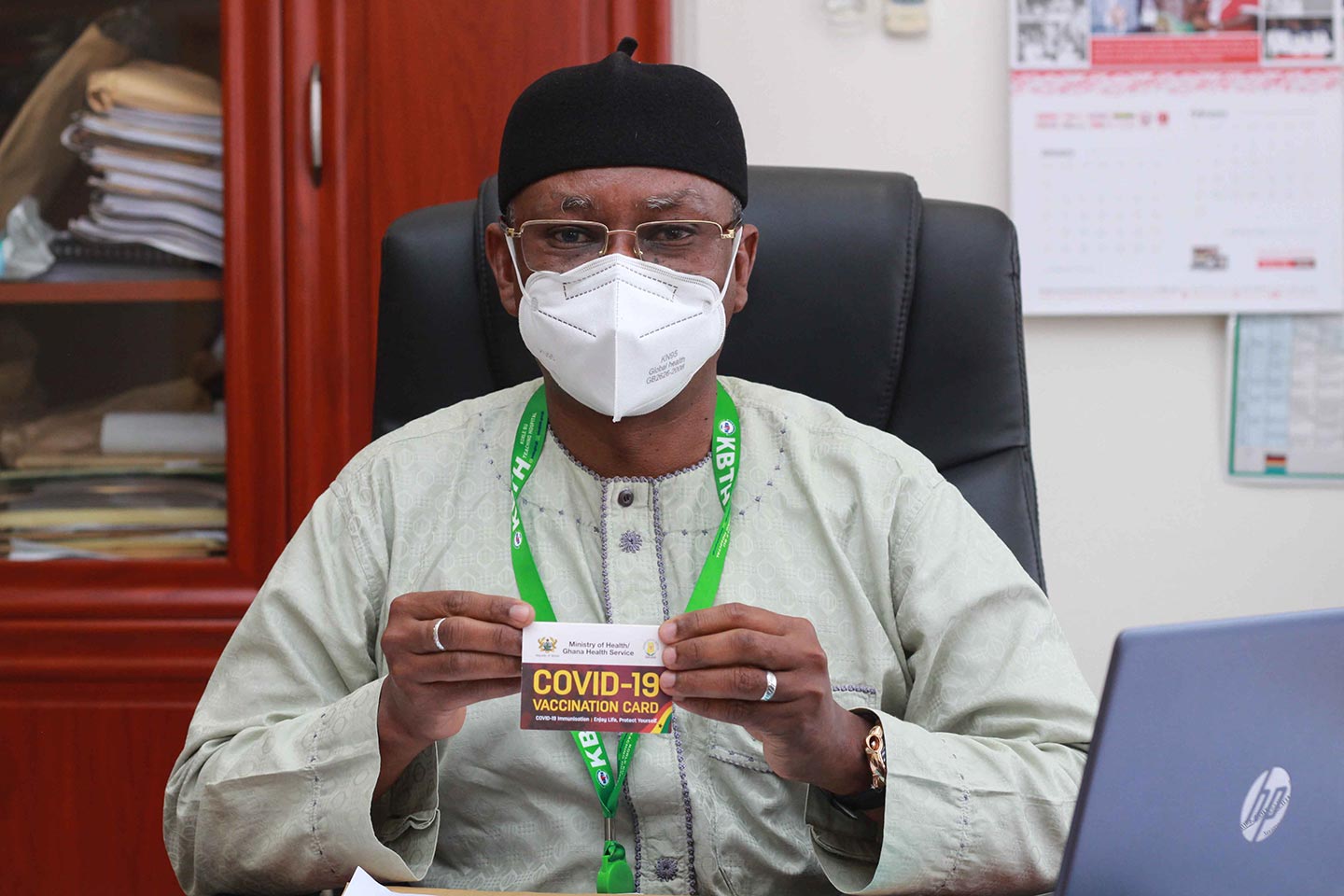
“I usually tell my colleagues – I have lived COVID,” says Dr Ali Samba, seated at his desk at Korle-Bu Teaching Hospital in Accra. A sliver of his face is visible between his black kufi cap and white medical mask: salt and pepper eyebrows, gold-rimmed spectacles and a clear gaze. As the Director of Medical Affairs for Ghana’s leading referral hospital and leader of the national COVID-19 case management team, Dr Samba has had a close-up view of the “ravaging effects” of the pandemic on his country. “I know what COVID has cost,” he explains, “socially, economically and in the loss of life.”
Gavi/2021/Jeffrey Atsuson
He speaks from personal experience. In June, while Dr Samba was on a national tour of COVID-19 treatment centres, he learned that his younger sister in Kumasi was sick with a cough and had been sent to hospital. He arrived in Kumasi the following day. By then, his sister had tested positive for the new virus. “By the third day, she had passed,” Dr Samba says. “It was a big, major impact for me and for my family as a whole.”
If that was the darkest point of Dr Samba’s pandemic, today is a bright spot. It’s Friday 5 March, and Ghana is sailing out of its first week of the COVID-19 vaccine roll-out. Dr Samba is enthusiastic: since Tuesday, some 3,000 frontline health-workers at Korle-Bu have received their jab. Turnout has been excellent. “I’m very excited about the response of staff in Korle-Bu Teaching Hospital,” Dr Samba explains, “because it’s my responsibility to protect them as much as possible.”
For Dr Samba, who says he has been getting ready for the roll-out since vaccine candidates first showed promise in trials, Ghana’s inaugural delivery of vaccines could not have come soon enough. In countries like Ghana, where ICU and critical care capacity “is not that adequate”, the adage “prevention is better than cure” resonates, he says. The 24 February brought relief. Refrigerated trucks received 600,000 doses of COVAX vaccines on the tarmac of Kotoka International Airport, and transported them to the national cold rooms on the Korle-Bu site. From there, vials were dispatched towards the regions. Some 13,000 doses remained in place, though, earmarked for use at Korle-Bu. On the morning of Tuesday March 2nd, Dr Samba got his jab. Notwithstanding some minor side-effects – a bout of night-chills, a short-lived feeling of weakness and some soreness at the injection site – it has “been a great experience.”
Have you read?
Outside it’s a warm day stirred by a lazy, gusting breeze. The colonnaded entry bay of the hospital’s Accident Centre jetties out towards the street beneath the fat broccoli crown of a tree, and above the tree, the sky has the smudged, dense glow of the season’s already humid weather. The hospital has expanded tenfold since its establishment in the 1920s, and ranks now as the third-largest in Africa. But the campus is quieter than usual. Elective cases have been halted through the pandemic, and numbers at the out-patient department are way down.
Gavi/2021/Jeffrey Atsuson
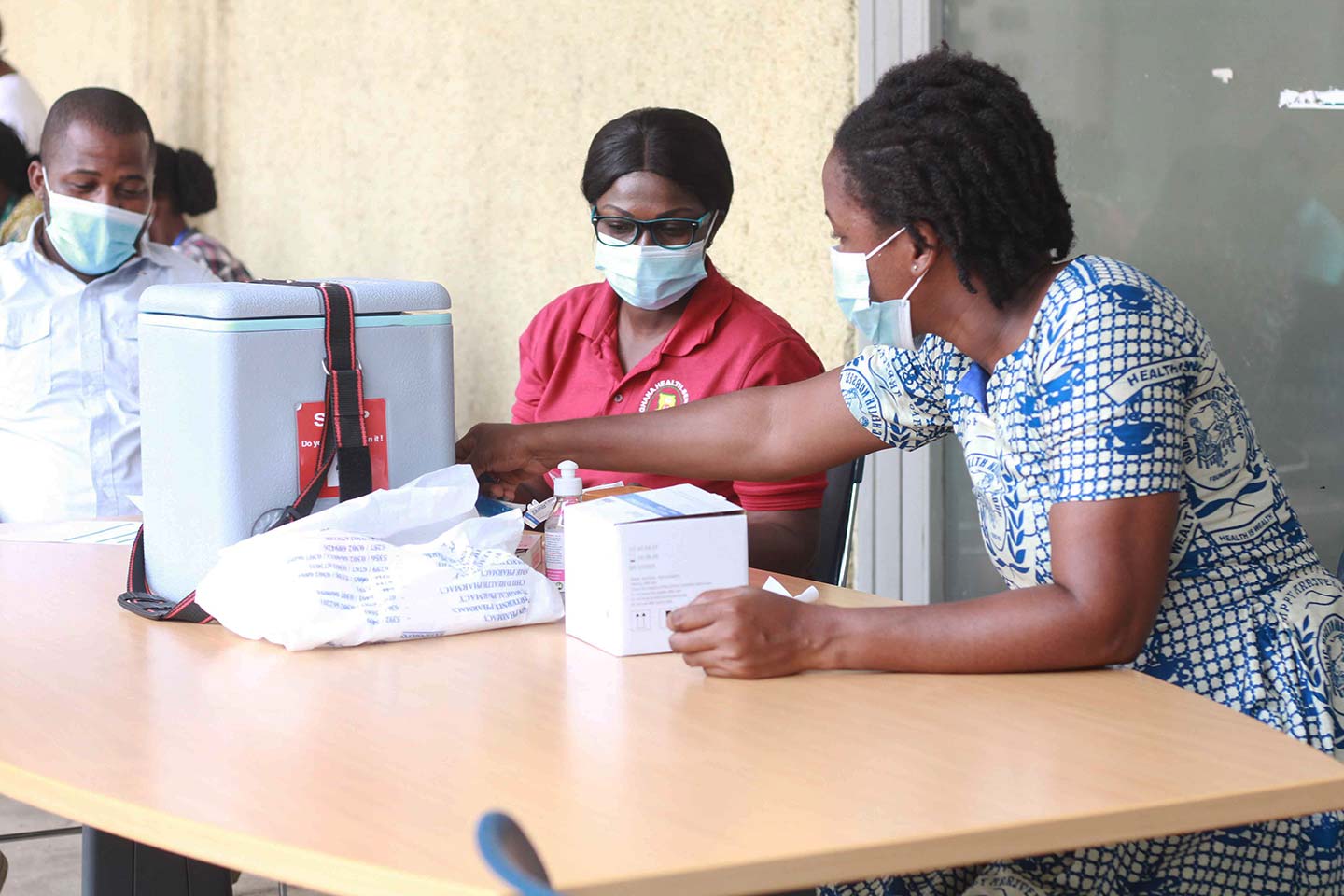
But at a wooden table on the outdoor walkway by the OBGYN department, health workers are registering a seated queue of vaccinees. “Most of our clients are scared of needles, and pray – but once we calm them down, we’re good to go,” says Senior Midwife Obeng, who has the kind of unfussy confidence one might yearn for, as a patient. Obeng has felt the pandemic’s restrictions most keenly at work – she has regretted the necessarily economical contact with patients. But, she says, “it’s all good. We’ll be fine. I’m optimistic that if we all decide to take the jab, we’ll all be fine.”
At the National Cardiothoracic Centre, which occupies a wing that juts out from the main hospital building, the pace of vaccination has been picking up each day through the week, but Margaret Safua Hammond, a senior nurse, is reluctant to call the burgeoning demand a challenge. “Today we are working as expected! I think we are really enjoying it,” she says.
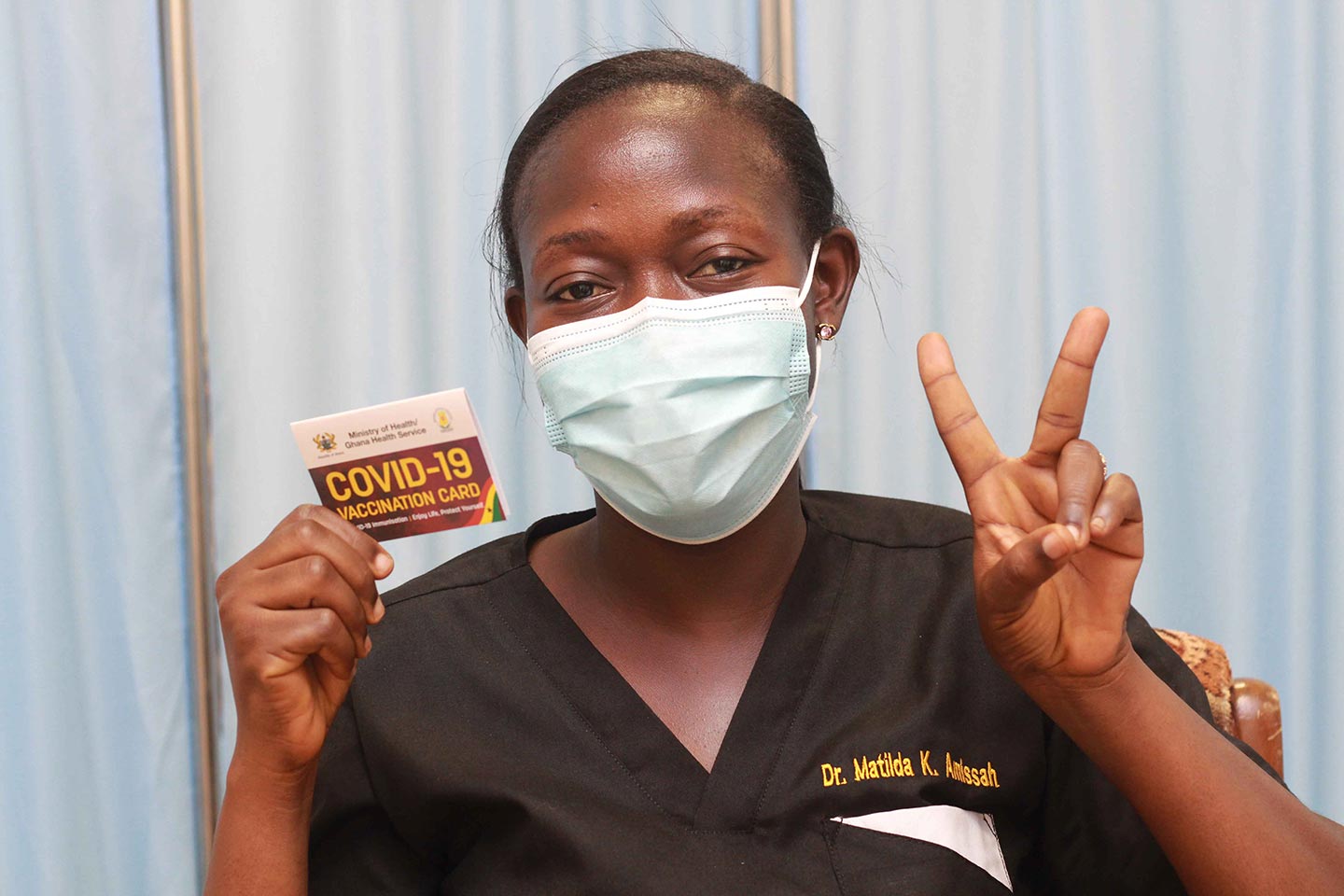
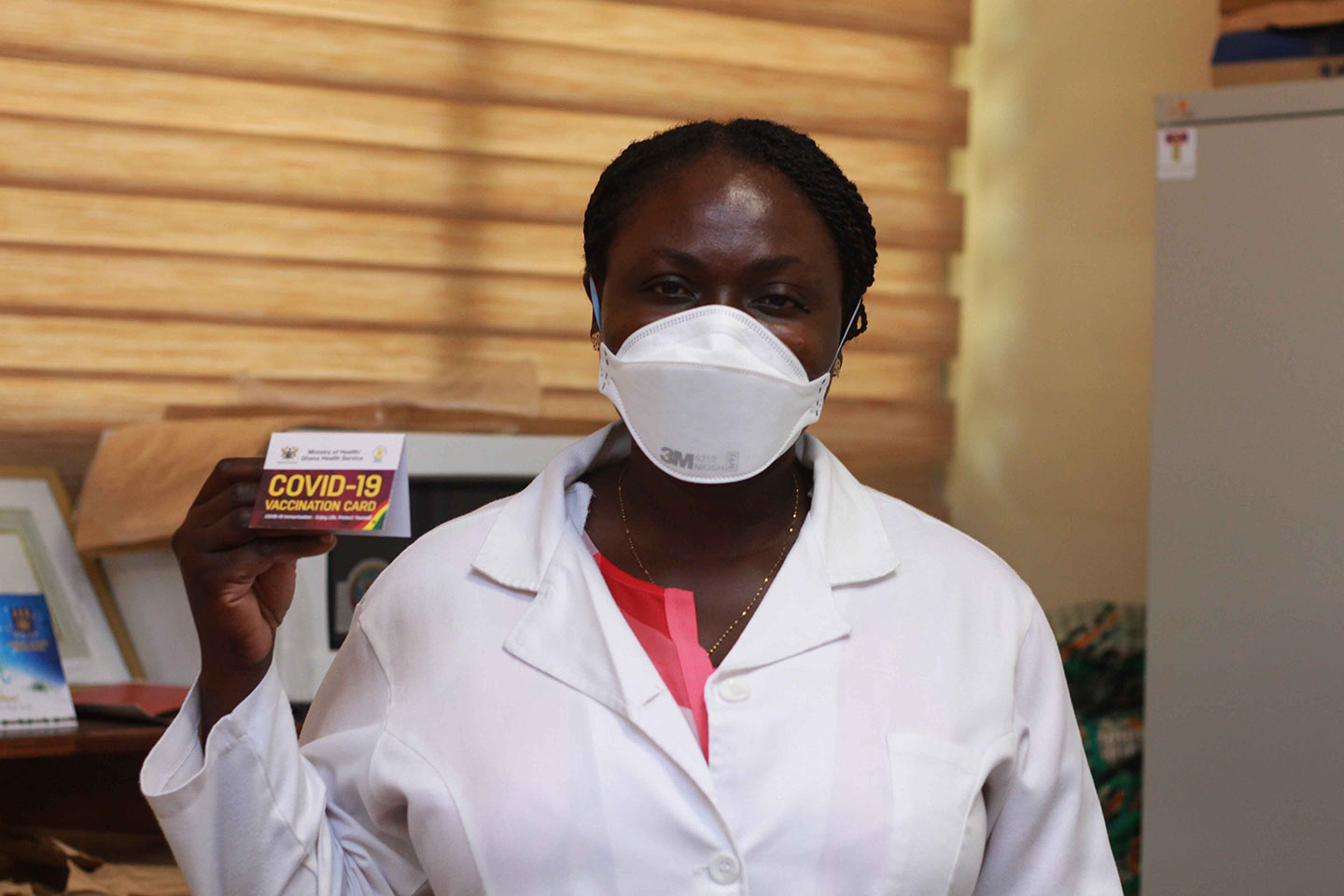
Gavi/2021/Jeffrey Atsuson
Among the vaccinees is Dr Matilda Amissah, who dabs deftly at her own injection site with a cotton-wool ball after the nurse withdraws the needle, and flashes a “V for vaccine” – at cameras. Waiting the mandated 15 minutes for observation post-jab is Dr Josephine Akpalu, who speaks haltingly as she remembers colleagues lost to the coronavirus. Head of Department for Medicine and Therapeutics for the University of Ghana Medical School, Dr Akpalu wears a white medical coat and turns her eyeglasses over and over in her fingers. “Although I haven’t had the disease, I’ve had to change the way I practice medicine,” she says. Teaching has changed, too – what were daily contact hours with students were pared back to weekly sessions on the ward. Come to think of it, Dr Akpalu says, everything has changed: church, birthdays, funerals. After all that, how does it feel to receive the vaccine? “Oh!” she exclaims, “Really – it was nothing big!”
Gavi/2021/Jeffrey Atsuson
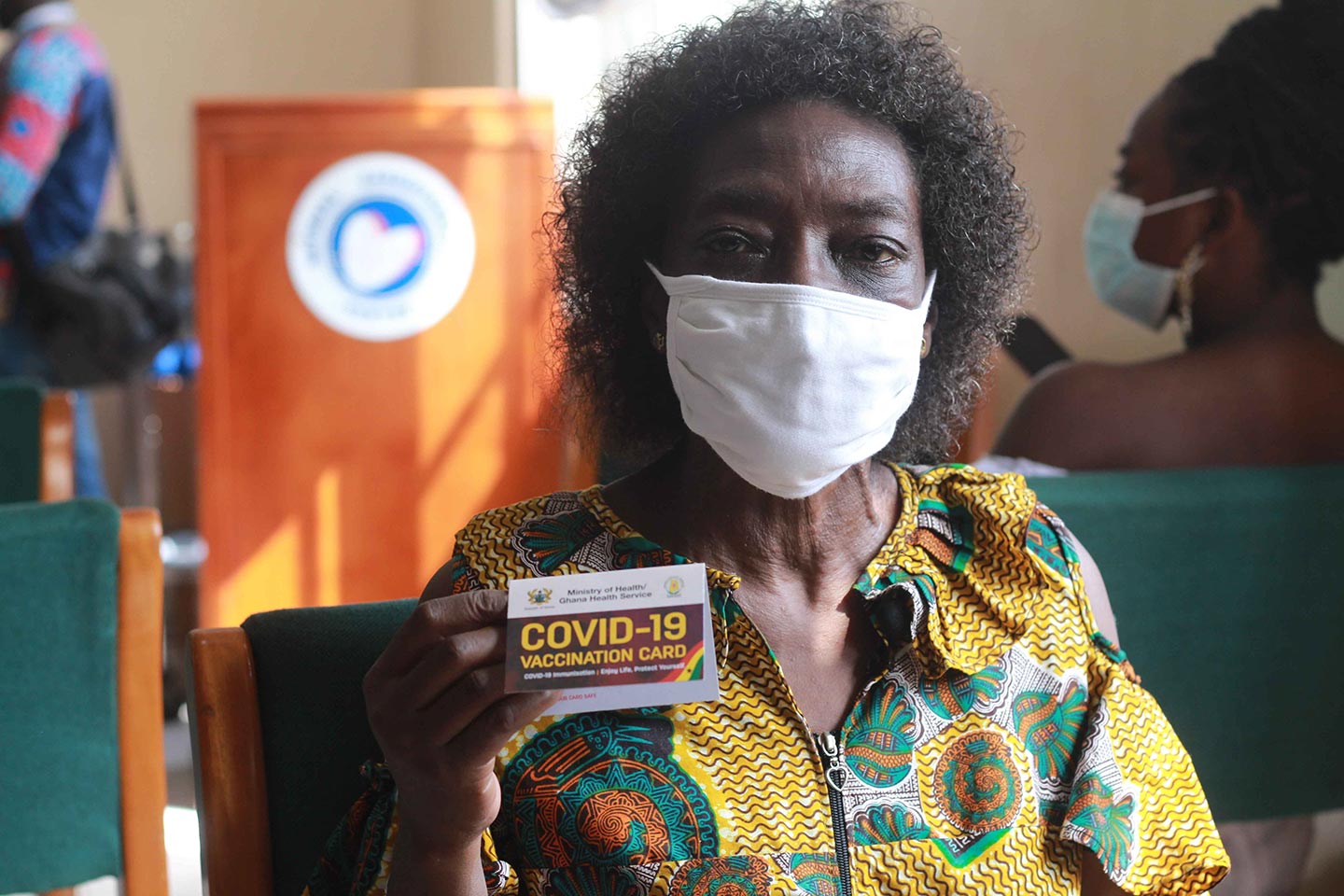
“I hope I look good. Is my hair alright?” laughs Dorothy Boadu, a nurse and a heart patient at the Centre, as the VaccinesWork camera finds her. She is middle-aged, small and thin, with a quavering voice and precise, teacherly consonants. Her hair, a halo of combed curls, is, just as she hopes, perfectly alright. Earlier in the day she received a call from her doctor notifying her she was eligible for vaccination, she says, “so I decided to rush over.” Boadu felt no anticipatory anxiety, she says, and indeed, “it was just a little jab, the expected prick. It wasn’t bad at all.” She laughs again, “there’s nothing to fear – nothing to fear but fear itself.”
Gavi/2021/Jeffrey Atsuson