
From compost to clinic: the fungus that could let Africa design its own vaccines at a dollar a dose
A South African team has turned a fungus pulled from compost into a vaccine platform that’s cheap, scalable and built so that Africa can design its own vaccines, rather than just packaging those made elsewhere.
- 29 June 2026
- 7 min read
- by Mandy Collins
At a glance
- A fungus-based vaccine platform being tested at a South African university could yield a new way to produce low-cost vaccines on the African continent
- Unlike some vaccine production platforms, doses are stable under refrigerated conditions and do not require freezing, which is an advantage for distribution in remote areas.
- An early vaccine made on the platform, against livestock disease Rift Valley Fever, has proven safe and effective in animal tests, and the team are planning to test an HPV vaccine with the same platform.
When novel vaccines undergo production and testing, a single batch needed for use in safety and efficacy trials can cost millions – the kind of numbers that quash most African-made vaccines before they get anywhere near a clinic. Now, a team at the University of the Witwatersrand (Wits) in Johannesburg, South Africa, believes it can cut that cost significantly, using a vaccine platform based on a fungus that was originally pulled out of compost.
The goal is to create a virus-like particle cocktail from multiple HPV subtypes to extend protection beyond what current vaccines offer.
The early results are encouraging. A first vaccine candidate built on the platform, targeting the livestock disease Rift Valley fever, has already come through an animal challenge study safe and protective, with field trials planned for next year. If the approach holds up, the team believes it could eventually make some vaccines (including for human papillomavirus [HPV], which causes cervical cancer) for around a dollar a dose. Crucially, this could allow Africa to tailor its own vaccines rather than rely on importing them from other regions.
Why fungus?
Vaccine platforms are the underlying technologies used to safely teach the immune system to recognise and fight off harmful viruses or bacteria. Instead of using a whole, live infectious organism, some vaccines use specific pieces, blueprints, or harmless carriers to trigger that crucial protective response.
The new fungal C1 platform was developed by Dyadic International in the US and originally used for industrial enzymes before being repurposed for vaccines and therapies, says Dr Kubendran Naidoo at the Wits Vaccines and Infectious Diseases Analytics Division and the Antiviral Gene Therapy Research Unit. Wits has access to C1 through a tech transfer and licence agreement with Rubic One Health, a South African group of partners providing affordable and accessible vaccines.
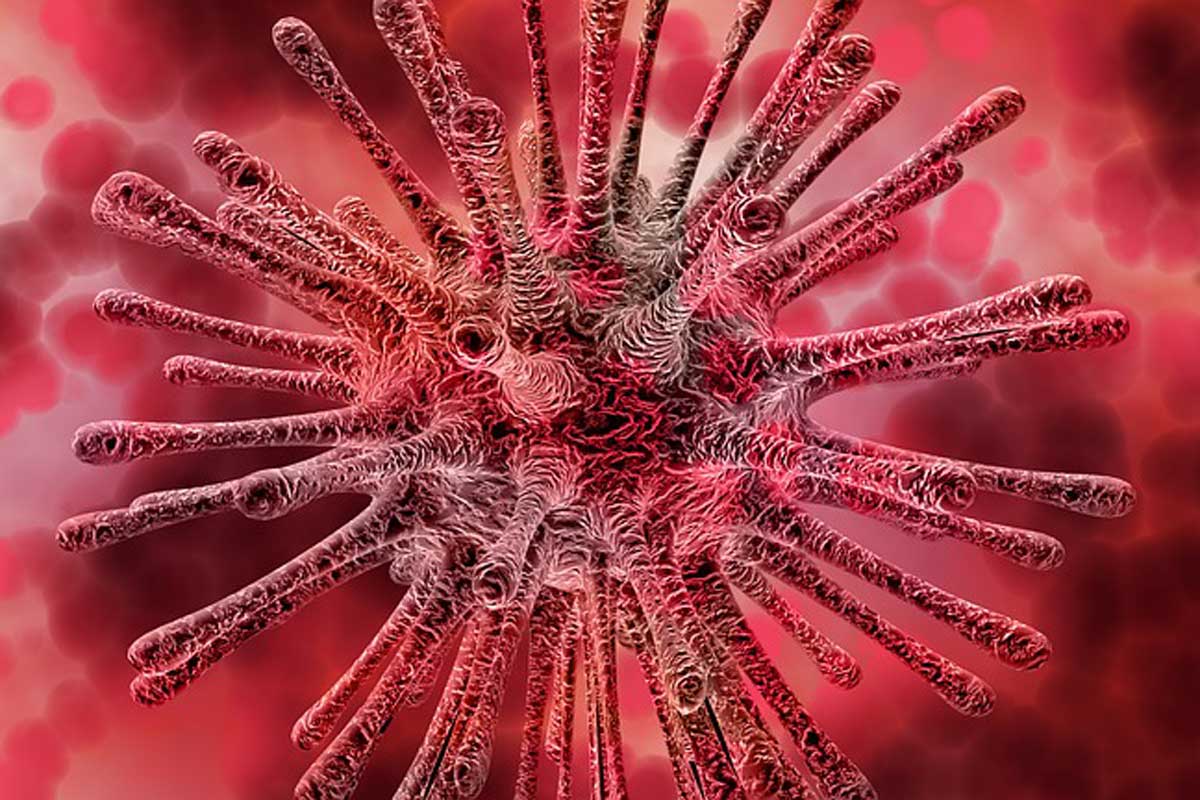
The platform uses recombinant protein production: foreign DNA is inserted into an engineered host organism (in this case a fungus) and the cell’s machinery builds the target protein. C1’s draw is that it produces these vaccine proteins in large amounts, cheaply.
“Most laboratories avoid fungus due to contamination risks in cell culture, but the C1 strain has been modified such that it does not sporulate, so it doesn’t persist in the environment – which is part of what makes it manufacturable,” he explains. And it’s fast: “We can develop cell lines in two months versus roughly six months for mammalian systems.”
This makes it accessible to South Africa and other low- and middle-income countries (LMICs) because it uses ordinary microbial fermentation and conventional molecular biology techniques, skills that already exist locally, rather than the specialised infrastructure other platforms demand.
It’s also animal-free, and uses simple growth media such as sugar, yeast, minerals and vitamins, which means it’s both cheap and it sidesteps the supply chain problems with using an animal serum.
Low cost, stable supply chain
Both cost and reliable supply matter here. Naidoo and his team believe the C1 platform could significantly cut costs to a fraction of existing vaccines, especially for tailor-made, regional-specific vaccines.
Have you read?
At the height of the COVID-19 pandemic, supply disruptions showed just how fragile access to vaccines can be, particularly for LMICs. But in South Africa (and sub-Saharan Africa) there’s an additional factor: Dr Rebecca van Dorsten, a postdoctoral fellow working alongside Naidoo, says that current vaccines cover HPV-16 and -18, but in sub-Saharan Africa, HPV subtype 35 is becoming more prevalent.
“In several parts of Sub-Saharan Africa, we’re seeing it show up more than HPV-18, both in HPV infections and in cervical neoplasia,” she says. “So, the thinking is to first build a trivalent vaccine that adds HPV-35 to -16 and -18 – complementary to the current programme – and eventually move toward a nonavalent vaccine that includes HPV-35 from the start.” The current nonavalent option is expensive for Africa, she notes, which is partly why it hasn’t been rolled out in the country’s public sector programme.
The goal is to create a virus-like particle cocktail from multiple HPV subtypes to extend protection beyond what current vaccines offer.
An added advantage is the platform’s thermostability. C1-produced subunit proteins are refrigerator-stable (2–8°C) rather than needing frozen or ultra-cold storage like mRNA vaccines – which has huge potential for both access and distribution in remote and/or rural areas, where the cold chain might be more difficult to maintain.
Rift Valley fever vaccine: the proving ground
In the meantime, the team has been using the platform to design veterinary and zoonotic vaccines against Rift Valley fever (RVF), because the existing live-attenuated veterinary vaccine has safety concerns, particularly for pregnant ruminants, due to high abortion rates – a factor the team could improve on.
They deliberately started with veterinary vaccines to build the platform’s track record and technical credibility before pushing toward human applications like the HPV vaccine.
The team produced an RVF antigen and ran safety studies directly in sheep, but encountered a hurdle with lack of regulatory accredited facilities to host a challenge study. More specifically, they required a Biosafety Level 3 (BSL-3 facility), a highly controlled, specialised laboratory used for work with dangerous microbes and pathogens that can cause serious or potentially lethal diseases that can be transmitted to humans.
No local alternative existed, so together with Rubic One Health, they turned to a partner institution in Kenya instead, where they ran a small, controlled challenge study. The vaccine candidate was shown to be safe and protective relative to controls. They plan to run field trials in 2027.
There is also a second, early-stage C1-based veterinary project on brucellosis (a serious and often neglected zoonotic disease) running in parallel – to establish this fungal system as a platform technology in the country.
Beyond Africa as a ‘fill-and-finish’ station
It looks likely that the platform will help drive local and continental vaccine manufacturing and distribution, and help design new vaccines, which isn’t something that currently happens in Africa, says Naidoo.
“People talk about Africa ‘doing manufacturing’, but it’s usually fill-and-finish, not genuine manufacturing or design in an end-to-end vaccine development and production pipeline,” he says. It’s comparable to the way the benefits of mining in Africa have been seen elsewhere and not in the countries, or even the continent, where those resources are mined.
This makes the Gavi-supported African Vaccine Manufacturing Accelerator (AVMA) the kind of destination incentive structure this work is ultimately aimed at. AVMA is a financing mechanism that will make up to US$ 1.2 billion available over ten years to support the sustainable growth of Africa’s vaccine manufacturing base.
It was launched specifically because Africa does mostly packaging-stage work rather than design, and it now financially rewards moving up that ladder – the exact gap C1 is positioned to close.
“Design matters because it speaks to innovation, which Africa needs to catch up on,” says Naidoo. “We’re trying to tick a lot of boxes with a small team, but if we get this right, the conversation changes.”
David vs. Goliath
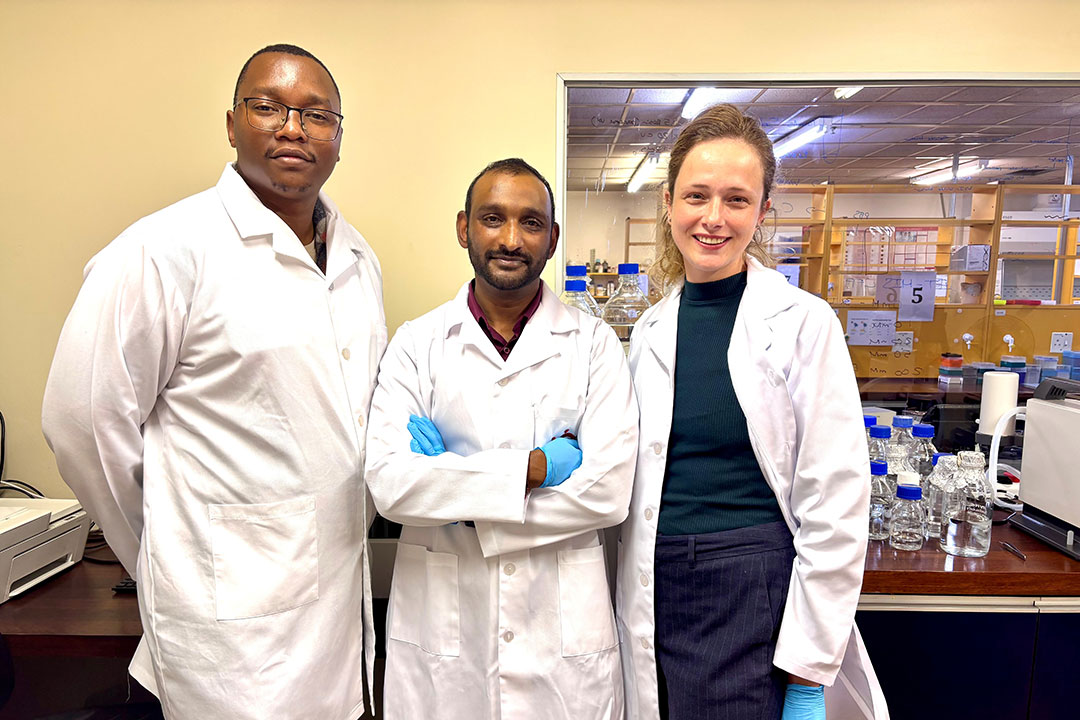
And it is a small team – Naidoo, Van Dorsten, Dr Ofentse Matlhabe (another postdoctoral fellow) and two MSc students, one on a novel HPV project, and one modifying C1 for broader application. “We are resource-constrained, and we have a lot to prove,” says Naidoo. “It’s a vision that’s very difficult to do quickly, and we have sceptics as well, because there are so many gaps to address. That makes it difficult to get resources, so we’ve had to find ways to make things work – including sacrificing some sleep.
“We’ve got the passion, we’ve got the drive, we’ve got the ideas, we’ve got the plan. What we are lacking is resources and more local capacity. This is a bold and meaningful task. We’ll take all the help we can get, because that is what it takes to make this happen.”
The team also has support from the scientists such as Prof Shabir Madhi, Professor of Vaccinology and Dean of the Faculty of Health Sciences at Wits, who has helped to drive the platform forward. “The C1 platform provides an opportunity for efficient, high throughput manufacturing of vaccines, monoclonal antibodies and other proteins,” he says.
“If successful, it offers potential for local manufacture of certain vaccines, which could be more cost-effective, and hence more accessible compared with currently licensed vaccines.”
More from Mandy Collins