
What – or who – wiped out most of the indigenous people of the Americas?
Can we really blame smallpox, measles and other imported pathogens for the “Great Dying” that followed European arrival in the New World?
- 26 October 2026
- 14 min read
- by Maya Prabhu
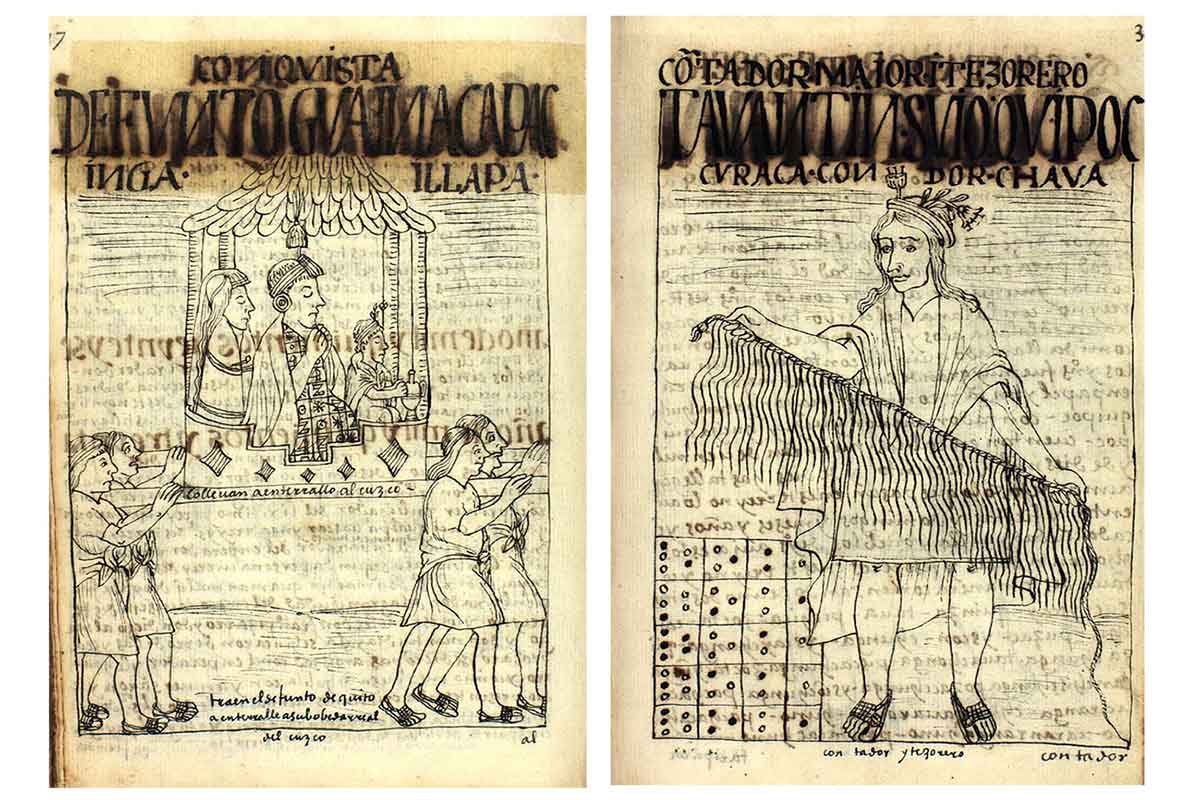
“…The hand of God fell heavily upon them, with such a mortall stroake, that they died on heapes, as they lay in their houses; and the living, that were able to shift for themselves would runne away and let them dy, and let there Carkases lay above the ground without burial. For in a place where many inhabited, there hath been but one left a live, to tell what became of the rest; the livinge being (as it seemes) not abel to bury the dead, they were left for Crowes, Kites, and vermin to pray upon.”
- Thomas Morton, settler, describes the “spectacle” of a plague arriving among indigenous people near Massachusetts. New English Canaan, 1637.
Less than 30 years after Christopher Columbus’s trio of vessels first dropped anchor at the Caribbean island called Guanahani by its Lucayan inhabitants, the Lucayans were all but extinct as a people.
The decades advanced, the ships kept coming, and so did the destruction of indigenous America.
The losses were so great – in lives, in cultural knowledge and memory, formal records, and archaeological traces – that we actually don’t know for sure how much there had been to lose before 1492.
As a consequence, scholars have spent the last many decades defending astonishingly divergent accounts of indigenous depopulation in the first couple of centuries after Columbus.
Old World pathogens were certainly at play
Divergence aside, pretty much all of these accounts, and emphatically the most famous of them1, assign a decisive role to imported viruses and bacteria.
Along with white people and their animals, European ships carried pathogens (inside the people and animals) that were old in the Old World and new to the New World. They included smallpox, plague, measles, influenza, yellow fever – terrible and deadly even in the places where they were already familiar.
Many contemporary sources describe epidemics of these diseases burning through indigenous populations with conspicuously high rates of death. When smallpox came to Hispaniola in 1507 it killed so many of the island’s original inhabitants, many of whom had already been murdered or enslaved by the new arrivals, that the Spanish brought in shiploads of enslaved Africans to meet their labour demand.
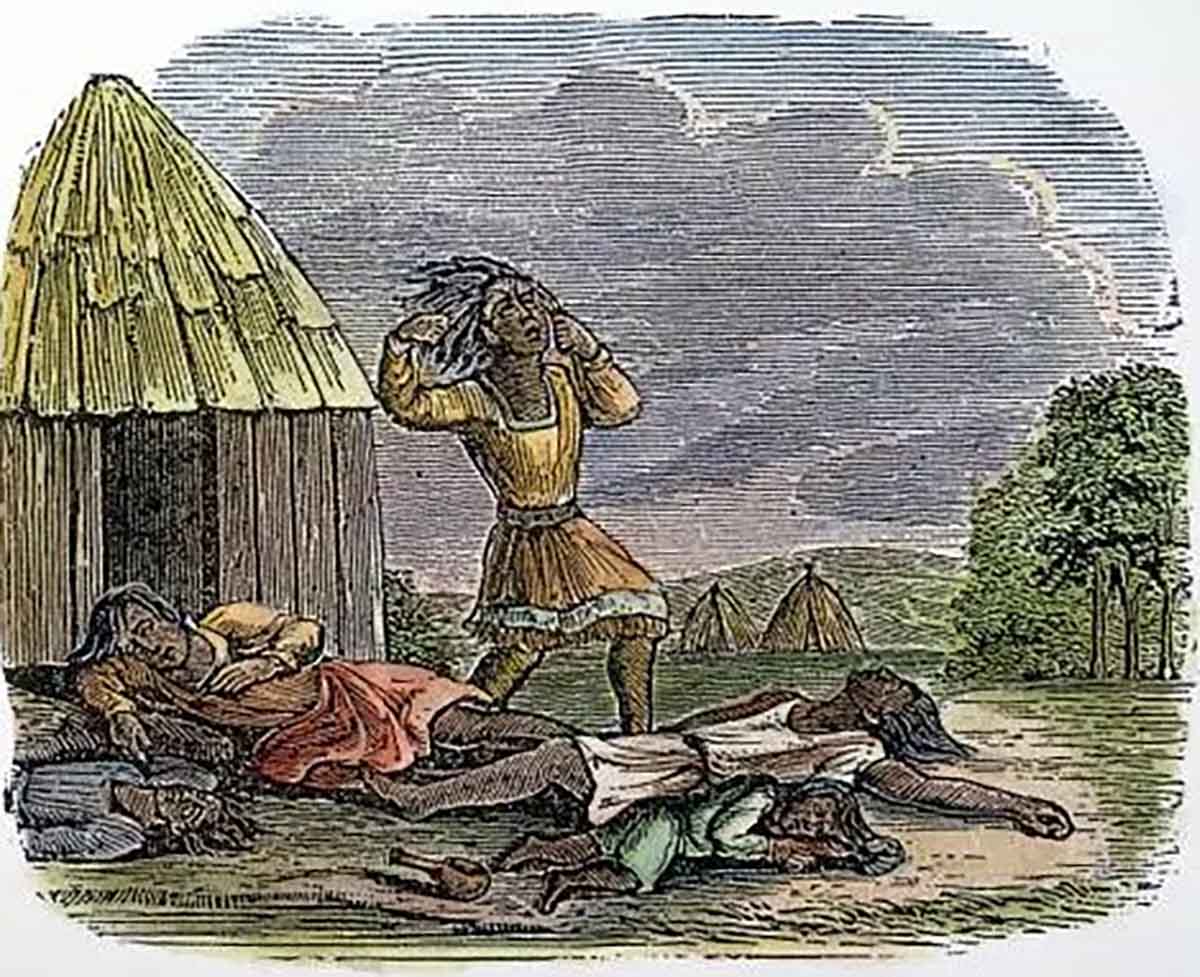
Smallpox struck Hispaniola again in 1518, killing a third of the remaining native people. It hopped to the mainland in 1520 and swept through Mexico.
“Year 2-flint, 1520. Then there was the plague [çahuatl] which caused great mortality. From it died the Huehue Yotzintli Tlayllótlac Teuhctli, Señor of Tzacualtitlan Tenanco Amagquemecan. He ruled thirty-three years. And from this same thing died his adviser… also of smallpox [çahuatl] died Señora Tlacocihuatzin…. From the same cause died Itzcahuatzin y Tlatquic, from Itzcahuacan, who succeeded in governing thirty-five years, and his own son.”
- Chimalpahin, Nahua annalist, describes a 1520 epidemic of disease variously translated as “plague” or “pox” in his Séptima Relación. Quoted in Robert McCaa’s “Spanish and Nahuatl Views on Smallpox and Demographjic Catastrophe in the Conquest of Mexico.”
It spread onward and, along some routes of commerce or conflict, it outpaced the Spanish. When Francisco Pizarro arrived at the borders of the Andean Inca realm in 1531, he found he had had indispensible help in his conquering mission: both Emperor Huayna Capac and his son Ninan Cuyochi had died recently from an illness that was very probably smallpox.
The empire was in disorder. It fell to the invaders in 1533.
Census data shows that by 1570, the Inca population had collapsed in half.
It gets more complicated: loss and “virginity”
Many modern scholars believe that by 1600, the entire native population of the Americas2 had decreased by as much as 90%. In 2019, a group of scholars connected that great demographic collapse to shift in the climate: enough farmed land had been abandoned and reclaimed by forest, they found, that atmospheric carbon levels dropped sharply and the planet cooled.
Although smallpox, like the other Old World diseases, was known to cause great mortality even back in Europe3, both qualitiative descriptions of epidemics in the Americas and quantitative assessments of contemporaneous population decline have convinced generations of historians that Americans were more susceptible to these pathogens than their white counterparts.
When smallpox came to Hispaniola in 1507 it killed so many of the island’s original inhabitants, many of whom had already been murdered or enslaved by the new arrivals, that the Spanish brought in shiploads of enslaved Africans to meet their labour demand.
At a very basic epidemiological level that’s plainly valid.
By the 1500s, smallpox was endemic in most European countries. It’s fair to assume that in a city like Paris or Madrid, a large part of the adult population at any moment in time had survived exposure to smallpox in childhood and had acquired immunity. When an outbreak sprang up, fewer people got infected, and smaller quantities of virus circulated.
Not so in Tenochtitlán. In that grand Aztec city, far larger and busier than London, prior exposure hadn’t forearmed anyone’s immune system; when the virus arrived, it arrived on so-called “virgin soil”.
The problem, according to David S. Jones, historian, medical doctor and current chair of the History of Science department at Harvard, is that some narratives of American depopulation have gone further, to claim that indigenous Americans lacked resistance to these diseases on an intrinsic level4, leaving them weaker than an equivalent, previously uninfected European.
In other words, the claim has been that native Americans didn’t just lack prior exposure, they had “no immunity”.
Many modern scholars believe that by 1600, the entire native population of the Americas2 had decreased by as much as 90%.
“When I started my graduate work in history, I was halfway through medical school, so I had gotten taught all the basics about microbiology and infectious disease and I was struck by how much of what historians and archaeologists and physicians wrote about the history of epidemics just made no sense in terms of what we actually know about infectious disease,” he told VaccinesWork in a recent interview.
“The claim that Indians had no immunity to European diseases was just taken at face value, and it was all over the literature. And the basic argument was, well, when the Europeans showed up, it wasn’t their fault that all the indigenous groups died. They just happened to carry all these diseases with them.”
Demographic estimates are, like everything, political
It’s worth spooling back a moment to cast an eye at the literature that Jones refers to.
In 2002, when Charles C. Mann wrote 1491, a colossally popular work of journalism first released as an article in the Atlantic, he found a “culture war” in the scholarship of post-Columbian depopulation. It orbited the question of the demographic baseline, which had been the subject of heated debate for decades.
That’s not as recondite as it may sound. Determining how many people died in the first centuries after contact (and therefore how quickly, and thus how) demands a starting-point idea of how many people were living in the Americas before the Europeans came.
This is a difficult question to answer, because the evidence is thin and consequently slippery to handle.
Although few people today would have the nerve to echo the claim made by American History: A Survey, once a standard high school textbook, that early America “stood empty of mankind and its works,” serious pre-Columbus population estimates have ranged from 8.4 million5 to 112.5 million6. That’s a very big range, and where you land on it has political importance.
It’s intuitive to think that the lowest of the so-called “low counters” – the historians who argued that the population of the Americas had never been all that high, meaning fewer people had been lost – functionally exculpated European colonisers. The emptier the Americas pre-1492, the smaller the relative harm done.
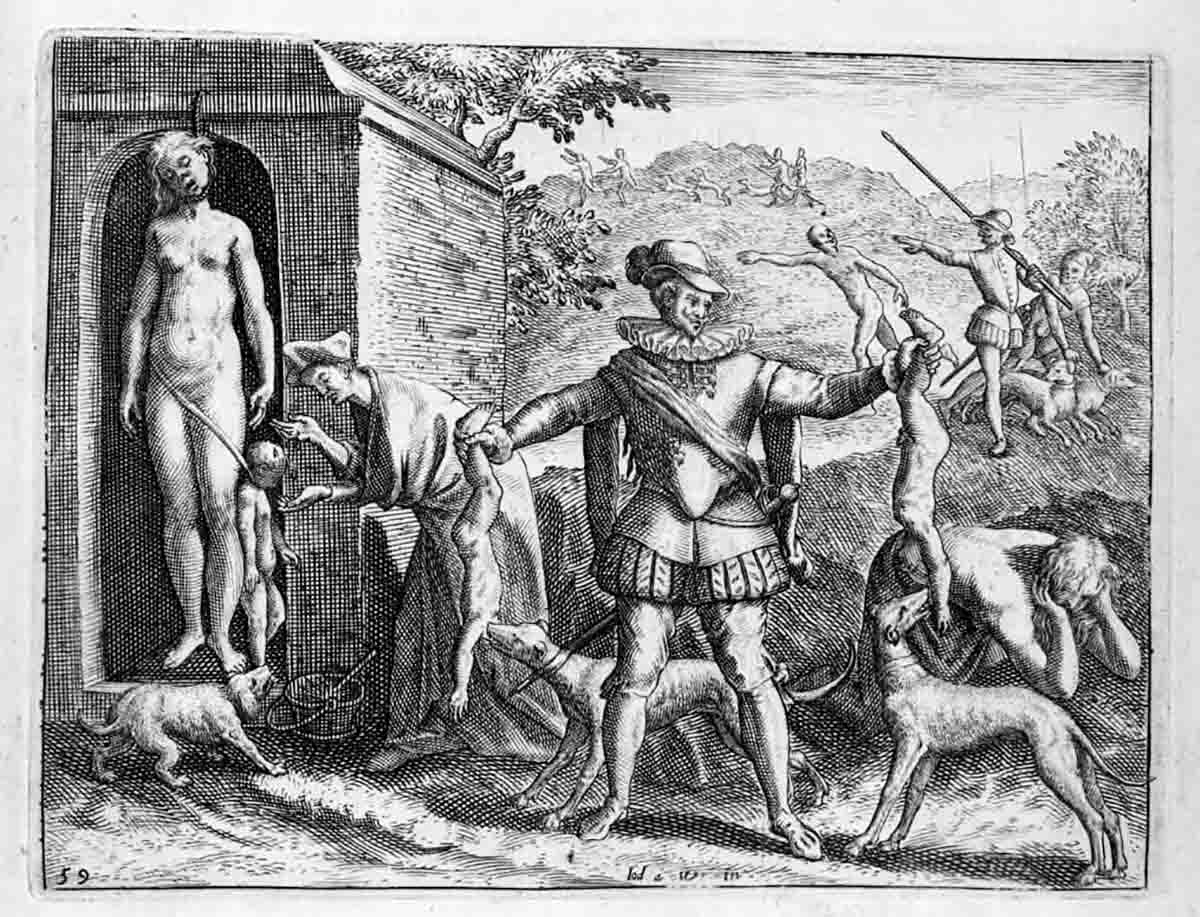
But Jones gets at why the highest “high counters” also diminish European responsibility for American depopulation. The top-end pre-contact demographic estimates7, which naturally provide for the most colossal of post-contact population crashes, are predicated on the assumption that epidemic disease was able to do near-total damage here.
Writing in the 1960s, Henry F Dobyns, the original “high counter” and source of that 112.5 million figure, described “a virgin population of susceptible individuals lacking immunities”, and posited that disease moved so quickly and so devastatingly through American communities that the first white explorers often – not just sometimes – arrived to unknown landscapes already emptied out by pestilence.
“The small pox has destroyed a great number of the natives in this quarter. It prevailed about 4 years since among the Clatsops and destroy[ed] several hundred of them, four of their chiefs fell victyms to it’s ravages. Those Clatsops are deposited in their canoes on the bay a few miles below us. I think the late ravages of the small pox may well account for the number of remains of vilages which we find deserted on the river and Sea coast in this quarter.”
- Meriwether Lewis, soldier-explorer, Friday February 7th, 1806. From the Original Journals of the Lewis and Clark Expedition 1804-1806, Volume 4
In other words, as a consequence of the host population’s inborn vulnerability epidemics of diverse Old World pathogens together constituted an unprecedented natural disaster – a single, terrible, biomedical phenomenon. Europeans had tipped the first domino; the rest was all but inevitable.
Horses, not zebras: native Americans have immune systems, too
But is it biomedically the case that native Americans really had next to no immunological resistance to these various diseases? Jones has argued no, most prominently in 2003’s Virgin Soils Revisted, an influential (though some, including Jones8, would say not influential enough) piece of revisionism.
Generating antibodies in response to exposure is just one part of how our bodies defend against disease, he notes, and there’s no reason to think indigenous Americans lacked the “innate” immune function that recognises and neutralises non-self cells even if they have never been encountered before.
Could American innate immunity have been poorer than Europeans? Could generations of exposure to pathogens have bred an evolutionary advantage into Europeans’ immune systems?
Theoretically, sure. But were the few hundred years that Europeans had lived at close quarters with smallpox likely enough to produce evolutionary effects? Probably not.
Meanwhile, studies of some extant virgin soil populations have shown immune systems that function normally. Confronted with measles, the isolated Yanomami of Venezuela and Brazil suffered high mortality, but without evidence of other innate susceptibility.
Survivors, in other words, acquired immunity much like anyone in Europe; there was no reason to suspect that a population thus affected wouldn’t rebound. Concrete evidence for oft-theorised American genetic inferiority9 has not been forthcoming.
Still, immunological determinism remains prevalent in the literature. When Charles C. Mann turned his article into a very popular book in 2005, he emphasised the significance of Americans’ congenital disadvantages.
Ten years later, Jones’s frustration was legible in the chapter he contributed to Beyond Germs, a fascinating collection of scholarship that does what it promises in the title. “Indian demography remains a Rorshach test on which scholars project their assumptions, interests, and biases,” he wrote.
When we spoke, he zeroed in on what those were: “This notion of Darwinian competition between races is really, really deeply engrained in the American consciousness. And some of it is to address the guilt that people might feel about the way that history actually did play out.”
Behind the microscopic scapegoats
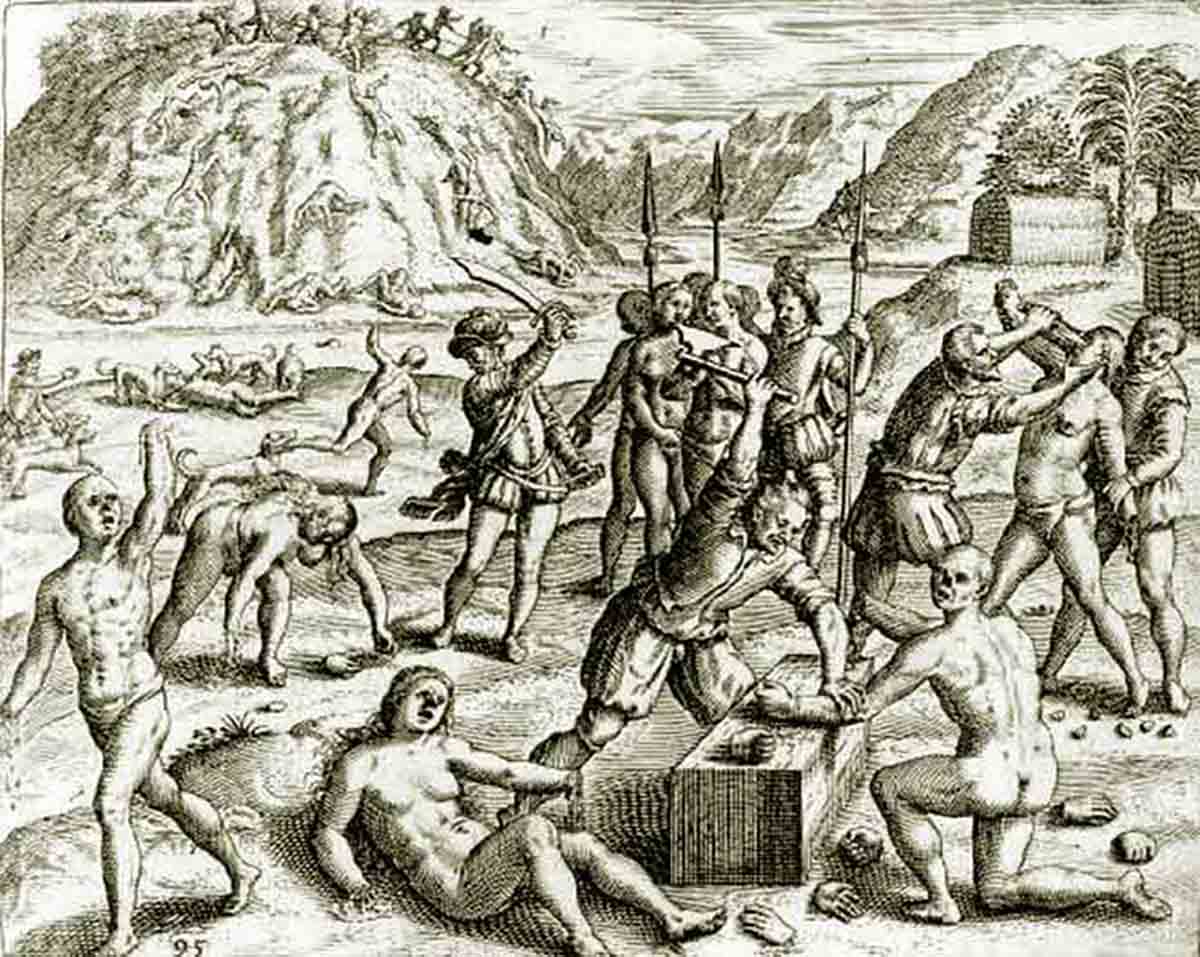
“…there came some Spaniards who immediately behaved like ravening wild beasts, wolves, tigers, or lions that had been starved for many days."
- Barolomé de las Casas, A Short Account of the Destruction of the Indies, 1542
So how did the history actually play out?
In the first place, it varied between places and across time. Even if there were, or had been, inborn immune differences between Europeans and indigenous Americans, it’s less likely that disease acted like an fantastical juggernaut than that it acted how it always does: contingently.
People who were doing well tended to fare better when faced with disease. The Comanches, who had horses, initially prospered in contact with Europeans and didn’t die in great numbers from smallpox and cholera until after 1840.
On the north coast of Peru, on the other hand, where indigenous communities had been forcibly resettled by the Spanish into “reducciónes” – crowded, centralised, closely controlled townships – depopulation reached highs of 93% between the 1570s and the 1640s.
Diseases cut quickly through communities who had been subject to colonial violence – had seen their family killed, been enslaved, been pushed off their land, alienated from their ways of life, stripped of cultural dignity, their social structures, their food security. Malnutrition alone makes people far more likely to die from infection.
“It was the turbulence of colonization and not genetic liability that created Indians’ devastating susceptibility to imported pathogens,” Jones clarified in his 2015 contribution.
That turbulence included the introduction of new pathogens, he told VaccinesWork: “Sure, they did that – or seizure of land, displacement, creation of refugee or migrant populations, enslavement, forced labour – I mean all the millions of kinds of things that the Europeans did to the indigenous groups left these groups profoundly vulnerable to the diseases that came with the Europeans – and probably also to diseases that had existed in the Americas before Europeans arrived,” he explained.
Health is social
A definitive tally of the dead in the early colonial Americas is unlikely ever to emerge. But modern estimates for the pre-1492 population are tending to converge around 50 million, with losses of 80–90% by 1600.
That seems like a great deal of death to fit into a single century. It calls to mind a meteor strike, a continent-sized avalanche; a supercharged epidemic disease fed fat on a population of sitting ducks.
The Americas in 1491 were probably home to about as many people as Europe. They were diverse, and so was their health, and colonialism tipped them – group by group, at one time or another – into vulnerability.
But Jones – who calls 90% loss of a 40–60 million population a “reasonable ballpark” – says it could very easily have happened in a more piecemeal manner.
“What does it take to convert a healthy population to two to three percent annual decline? It doesn’t take that much,” he said.
It takes less for a population already teetering on the brink. One making a living on poor land, for example, or the losers of regional wars.
The Americas in 1491 were probably home to about as many people as Europe. They were diverse, and so was their health, and colonialism tipped them – group by group, at one time or another – into vulnerability.
The scale and world historical impact of American depopulation is astonishing, but the mechanisms are likely to have been depressingly normal.
“If you look around the world today, obviously there are gargantuan health disparities,” Jones said. “Most epidemiologists, anthropologists, historians would say the inequities are the result of social forces.”
1. Jared Diamond’s Guns, Germs and Steel and Charles C. Mann’s 1491 and 1493 borrowed from existing scholarship to produce popular best-sellers, selling millions of copies. Both authors subscribe to narratives that make disease the single most important factor in post-contact American history. Both also emphasise native Americans’ lack of immunity in shaping the scale and speed of mortality.
2. The most densely settled portions of the Americas were in the Andes, and in modern Peru and Mexico. North America was hit later by both aggressive colonisation and disease, but the population of the landmass above the Rio Grande was smaller in any case.
3. Reports of mortality rates in the global historic literature vary from 10% to 100% for outbreaks of smallpox. The World Health Organization settles for “fatal in up to 30% of cases”. Where smallpox was an endemic disease of childhood, as in Sweden, case fatality rates could be as low as 8–10%, a disparity researchers attribute to social factors.
4. As Jared Diamond writes in Guns, Germs and Steel: “The main killers were Old World germs to which Indians had never been exposed, and against which they had therefore neither immune nor genetic resistance.”
5. Kroeber, 1939, referenced in Garcia-Putnam et al
6. Henry F Dobyns influentially pegged the population of the Americas pre-contact as 90 to 113 million, with those figures premised on a 90–95% depopulation rate as a consequence of Old World epidemics. In the storied battle between the “high counters” and the “low counters”, Dobyns led the “high counter” charge.
7. Dobyns began from the determination that calamitous epidemics often – and not just on occasion – preceded Europeans, depopulating the land before they could even explore, let alone ravage, it.
8. “There was a while where I would just obsessively check new textbooks when they came out and see how they explained it,” he told VaccinesWork, laughing. “And I used to get really, really angry when the old stories continued to circulate. Like: get mad – how come they’re not up with the current state-of-the-art, that is, with my research? And eventually I just got resigned to it.” More seriously, he offers an analysis of the appeal of the old immunological determinism in his 2015 follow-up to Virgin Soils, published as a chapter in Beyond Germs.
9. That’s not to say that there aren’t some grouped genetic differences that have bearing on function between different ethnicities. Africans have higher incidence of the sickle cell factor, evolved in defence against malaria. Indigenous Americans show lower MHC type diversity than Africans and Europeans. It has been argued that this made them more susceptible at population level – perhaps. But critically that doesn’t equate to “no immunity”.
More from Maya Prabhu
Recommended for you