
The women-only Facebook group boosting cancer prevention in Zambia
136,000 Zambian women have banded together online to help drive down the country’s sky-high rates of cervical cancer.
- 4 March 2026
- 6 min read
- by Ray Mwareya

At a glance
- Zambia has the third-highest cervical cancer burden in the world, with low rates of screening contributing to a tragically high mortality rate. Karen Nakawala, a survivor, founded a Facebook group in hopes of changing that.
- Within just a month of its establishment, the ‘Teal Sisters’ group had 120,000 members – big numbers in a country where fewer than one third of people are online.
- Six years later, the group can claim credit for starting what Nakawala calls a “domino effect” of health-seeking behaviours – screening, vaccination and open conversations about a too-often stigmatised disease.
Zambia has the third-highest cervical cancer burden in the world, with some 50 in every 100,000 Zambian women dying of the disease in 2022.
The urge to change that is what drives the ‘Teal Sisters’: a women-only Facebook community out to boost access to cervical cancer screening, prevention and treatment in Zambia.
“I always give myself as an example: that for me, an educated and fairly prominent person who is supposed to have information at my fingertips, I didn't know much about cervical cancer,” says Karen Nakawala, a director of Zambia Fashion Week, radio and TV presenter, MC and founder of the group.
“You could have prevented it”
In June 2019, a Pap smear followed by a biopsy confirmed that she had cervical cancer.
She recalls that her then-nine-year-old daughter said to her: “Mommy, why did you get cervical cancer when you could have prevented it with the HPV vaccine?”
“And, you know, I was like, oh, okay, there’s something like HPV?”
If HPV – the human papillomavirus – had ever crossed her radar, Nakawala certainly hadn’t clocked that the virus, which is responsible for more than 90% of all cases of cervical cancer, could be blocked by a simple jab. But for her, the window for prevention had closed.
She quickly realised the significance of the potentially huge information gap out there, that she intuited was likely to be even larger among vulnerable, less educated rural women than in her own circles.
While her treatment was underway, she was dismayed to learn of the stigma swirling around her society about cervical cancer, with the biggest misconception being that the disease afflicts women who are sexually promiscuous. No wonder that the hesitation to get screened or vaccinated persists, and that advanced-stage clinical diagnosis is consequently all too common in Zambia, she thought.
An online Hail Mary
So, in 2020, she started the Teal Sisters – something of a ‘hail Mary’ in a country where, according to , the internet penetration stood at just 24% that year (today, it’s estimated at between 30 and 33%).
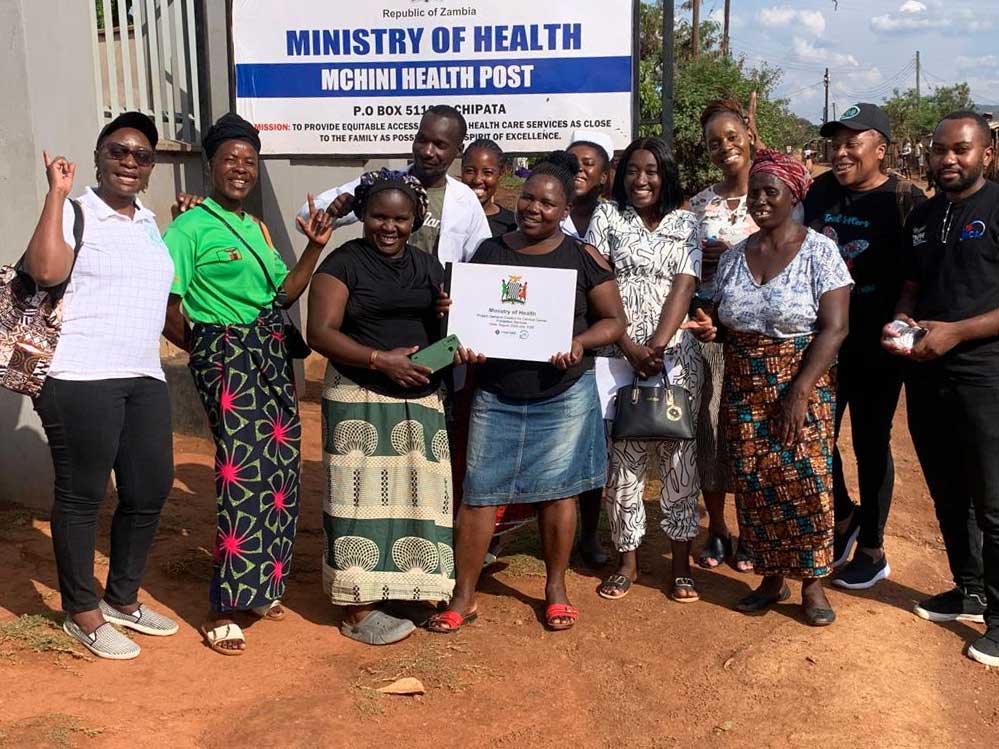
Credit: Karen Nakawala
“When we opened the page, within two weeks, we had over 50,000 women on the page. By the end of the month, we had over 120,000 women,” she recounts. Today, the group can boast a following of 136,000.
In simple terms, the aim was to create a safe, non-judgemental online space for women, with the power to propel an offline change. If women were able to give each other support and motivation to undertake regular screening for cervical cancer, to fight HPV myths, to get the vaccine for themselves and their daughters, and were able to offer emotional support to each other when they were undergoing diagnosis or treatment, that would already count as a transformation.
Have you read?
Six years later, that transformation is well underway. The online ‘Teal Sisters’ create demand for vaccination, screening and treatment in the real-world community through advocacy. Clinics, both public and private, then carry out those services.
“It’s a domino effect”
One week, the Teal Sisters Facebook platform hosts a survivor to talk about her journey. Another week, the group invites a doctor to talk about clinical symptoms to look out for, and to go over screening norms and treatment options. On another occasion, a dietician is invited to talk about nutrition for people recovering from cancer treatment.
“I just decided on my own, when I heard from the group for the first time in 2024, that screening is important,” said Zanji, 30, a rural housewife based in Chipata, a border region 574 km from the capital, Lusaka. She declined to give her surname, as she says the subject remains tinged with stigma.
But that hasn’t stopped her advocating for her friends’ health and safety. Once she found courage to start going for screening, Zanji passed the message on to women at her church, her children’s school and among street trader friends. They started going for screenings too.
That example-setting trend is one that Nakawala says she has noticed elsewhere in the group. Women who go for screening inspire their co-workers and friends. And, to Nakawala’s delight and surprise, she found that when a Teal Sister went to get screened, she often soon reported that her husband or boyfriend had sought out screening for prostate cancer, too.
“It’s a domino effect – I didn’t realise people wanted to do the right thing,” she says.
What’s driving that domino effect? Much of it is simple human empathy. The reason there was a huge uptick in the Facebook page’s following in just the first month of its existence was because people related to her, she says.
“I would like to believe I’m a public figure. I am a fashion designer and promoter. So, I think when women see a person that they know, a person like me go through diagnosis and treatment, they then realise that it could happen to anyone, could happen to them too,” she says. Her familiar face personified cervical cancer, bringing the awareness campaign down from the authoritative heights of the medical establishment to street level.
“A very good problem”
“It helps in boosting the numbers,” confirms Dr Stanely Samusodza, a physician who has worked at the intersection of HIV and cervical cancer in Zambia’s public hospitals, and is delighted that such specialised Facebook groups are helping to bring women into hospitals for potentially life-saving check-ups. Doctors, clinical specialists and nurses often don’t have the social draw of survivors who can meet women at eye level and declare: “Look, I had cervical cancer. I survived.”
Many Zambian women, especially those in rural areas, self-stigmatise when they have symptoms, he says. Some don’t even tell their husbands or their families out of shame, he says. So, by the time they go to the health centre, their symptoms have progressed – the bleeding is not stopping, they’re losing weight and their doctors may find that the cancer has already metastasised.
“It becomes management – not cure,” he says.
Nakawala agrees and says: “If you looked at the data now, we have about 3,680 women that are diagnosed with cervical cancer every year in Zambia. And out of that number, we have 60% of them dying. We want to help change that.”
The Zambia Ministry of Health has been very supportive of Nakawala’s Teal Sisters advocacy work.
“They provide the technical services. They provide the screening. And they provide the HPV vaccination,” says Nakawala.
She says the impact of the group’s awareness-raising was palpable almost immediately. In 2020, Zambian public health centres suddenly found themselves so inundated with women asking for screening appointments, that the centres were running out of consumables. The government had to beef up their supply chains and roster of health and support workers in the cervical cancer divisions.
“The demand for screening created a foot-traffic problem. A very good problem,” she says.