
Eligibility policy
Eligibility policy
Eligibility for Gavi support is determined by countries' national income
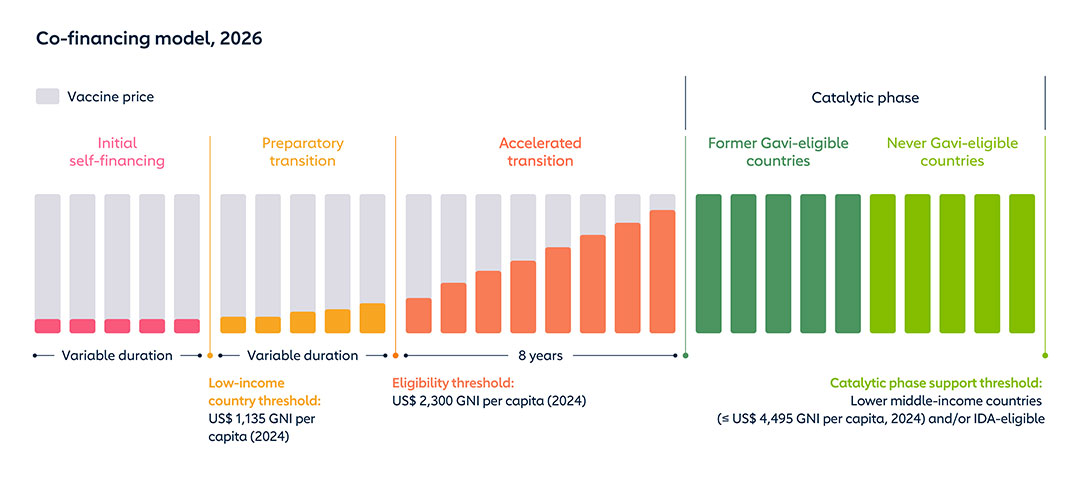
Gavi aims to focus its support on the world's lowest-income countries and therefore bases eligibility on national income. In 2026, countries become eligible for Gavi support if their most recent gross national income (GNI) per capita was less than or equal to US$ 2,300 (according to the latest World Bank data published in July each year).
Gavi-eligible countries can apply for new vaccine support, and health system and immunisation strengthening (HSIS) support. From the beginning of Gavi support, governments are expected to co-finance vaccines by financing a share of the needed doses. Gradually, as national income levels grow, co-financing levels for governments increase, as outlined in the co-financing policy.
Countries whose latest GNI per capita, or average GNI per capita over the past three years, falls below the Gavi eligibility threshold are classified as either initial self-financing (GNI per capita under the World Bank's low-income country threshold) or in preparatory transition phase (above the World Bank's low-income country threshold but still below the Gavi eligibility threshold). When a preparatory transition phase country’s latest GNI per capita and three-year average GNI per capita surpass the eligibility threshold, and when its co-financing share also reaches at least 35%, the country enters the accelerated transition phase.
Countries in the accelerated transition phase start to phase out of Gavi financial support over a period of eight years. Countries are eligible to apply for new vaccine support during the eight years of accelerated transition, provided that vaccine introductions during this phase effectively contribute to: strengthening routine immunisation; and increasing coverage and equity.
After eight years in the accelerated transition phase, a country becomes fully self-financing. Fully self-financing countries can no longer access new financial support from Gavi, though some types of previously approved support may continue. Several manufacturers have made commitments to continue providing these countries with access to prices similar to those Gavi pays, under specific circumstances and for a specified time period.
Gavi sets specific criteria for each type of support, as outlined in the Gavi support guidelines. All country applications are reviewed by a group of independent experts in routine immunisation, health system strengthening, epidemiology and disease control, cold chain and logistics, financial and budget analysis, and gender and equity.
In 2026, 56 countries are eligible to apply for new vaccine support from Gavi:
Initial self-financing
- Afghanistan
- Burkina Faso
- Burundi
- Central African Republic
- Chad
- Democratic Republic of the Congo
- Democratic People's Republic of Korea
- Eritrea
- Ethiopia
- Gambia
- Guinea-Bissau
- Liberia
- Madagascar
- Malawi
- Mali
- Mozambique
- Niger
- Rwanda
- Sierra Leone
- Somalia
- South Sudan
- Sudan
- Syrian Arab Republic
- Togo
- Uganda
- Yemen
Preparatory transition phase
- Angola
- Benin
- Cambodia
- Cameroon
- Comoros
- Guinea
- Haiti
- Kenya
- Kyrgyzstan
- Lao People's Democratic Republic
- Lesotho
- Mauritania
- Myanmar
- Nepal
- Nigeria
- Pakistan
- Senegal
- Solomon Islands
- Tajikistan
- Timor-Leste
- UR Tanzania
- Zambia
- Zimbabwe
Accelerated transition phase
- Bangladesh
- Congo
- Côte d'Ivoire
- Djibouti
- Ghana
- Papua New Guinea
- Sao Tome and Principe
ELIGIBILITY SINCE 2000
In Gavi’s first phase (2000–2005), the eligibility threshold was set at US$ 1,000 GNI per capita. Seventy-four countries were initially eligible to apply for Gavi support. Timor-Leste was added to the list of eligible countries in 2002, when it became an independent state.
In Gavi’s second phase (2006–2010), country eligibility was maintained at the initial level of US$ 1,000 GNI per capita. However, the reference year of the World Bank GNI data was updated to 2003. As a result, Kiribati dropped below the threshold and became Gavi-eligible. Meanwhile, Gavi support to China and Turkmenistan, and Ukraine a few years later, concluded.
During Gavi’s third strategic period (2011–2015), South Sudan became an independent state and was added to the group of Gavi-eligible countries. In the same period, support to Albania and Bosnia and Herzegovina came to an end.
During the fourth strategic period (2016–2020), new World Bank data classifying the Syrian Arab Republic as a low-income country meant that the country became eligible for Gavi support. In this period, 16 countries transitioned out of Gavi support, bringing the number of Gavi-eligible countries by the end of 2020 to 57.
During Gavi’s fifth strategic period (2021–2025), three countries transitioned out of Gavi support in 2022.*
At the start of Gavi’s sixth strategic period (2026–2030), the eligibility threshold was updated to US$ 2,300 GNI per capita for the year 2024. Two formerly transitioned countries, Angola and Timor-Leste, regained eligibility, raising the number of Gavi-eligible countries to 56.**
Since 1 January 2011, the eligibility threshold for Gavi support has been adjusted for inflation on an annual basis. For 2026, the eligibility threshold was increased exceptionally to US$ 2,300 GNI per capita, following a decision by the Gavi Board that aims to reduce the risk of unsuccessful transition for countries.
*As of 2022, 19 countries had transitioned to fully self-financing: Angola (2018), Armenia (2018), Azerbaijan (2018), Bolivia (2018), Bhutan (2016), Cuba (2018), Georgia (2018), Guyana (2017), Honduras (2016), India (2022), Indonesia (2017), Kiribati (2017), Mongolia (2016), Nicaragua (2022), Republic of Moldova (2017), Sri Lanka (2016), Timor-Leste (2018), Uzbekistan (2022) and Viet Nam (2020).
**As of 2026, two formerly transitioned countries regained Gavi eligibility: Angola and Timor-Leste.