

Gavi immunisation Supply Chain strategy (iSC) 2026–2030

The Gavi 6.0 immunisation Supply Chain strategy is tailored to support countries make vaccines available where they are needed, when they are needed. This is by strengthening the whole delivery system, from data and planning to workforce, infrastructure and coordination.
The strategy is country-led, focused on the most important bottlenecks, and designed to build long-term sustainability. It is about helping countries deliver better immunisation outcomes for all communities, especially those furthest behind.
Theory of change
Vision
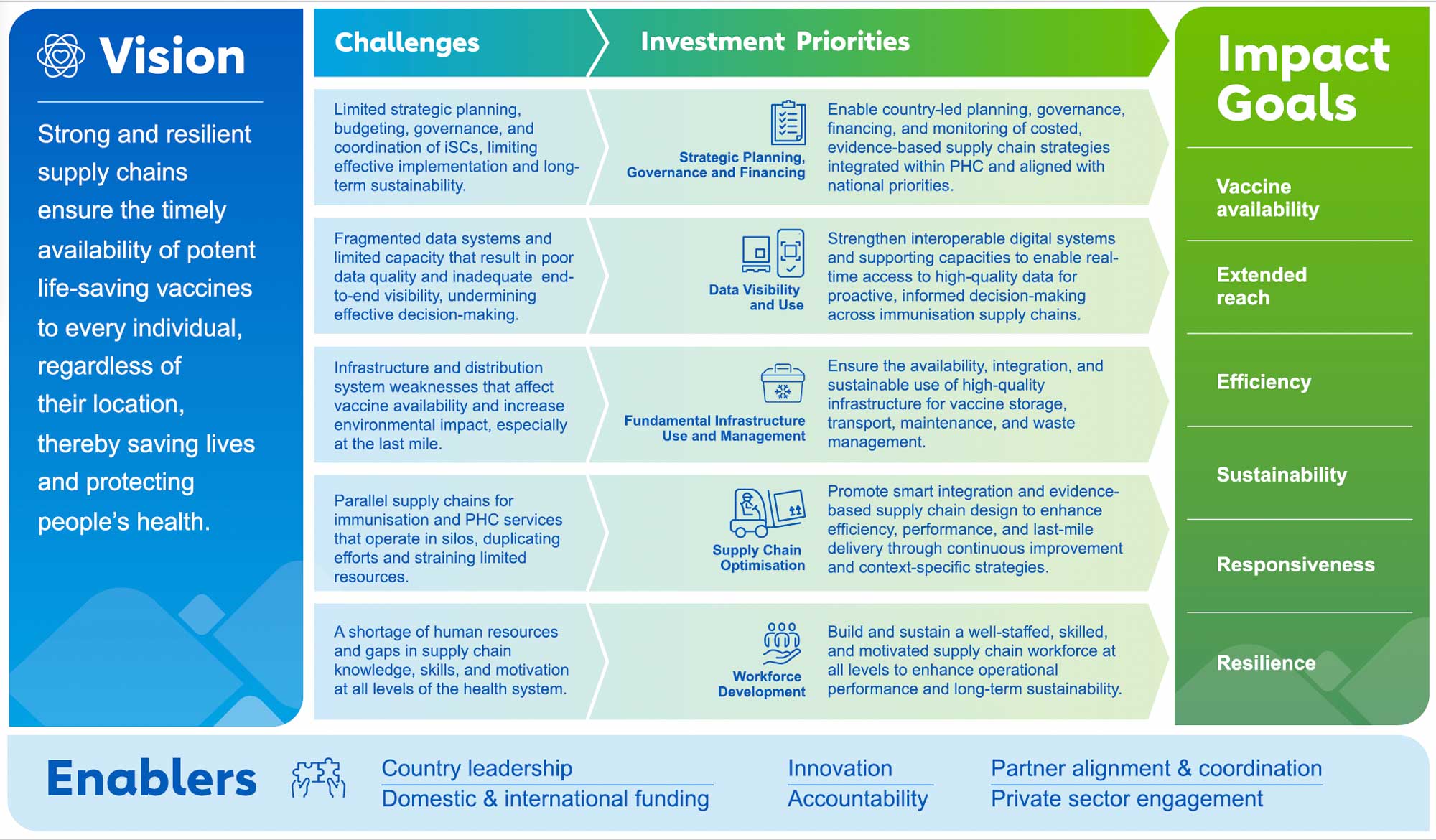
Strong and resilient supply chains ensure the timely availability of potent life-saving vaccines to every individual, regardless of their location, thereby saving lives and protecting people's health.
Strategic planning, governance & financing
Challenges
Limited strategic planning, budgeting, governance and coordination of immunisation supply chains (iSCs) limit effective implementation and long-term sustainability.
Investment Priorities
Enable country-led planning, governance, financing and monitoring of costed, evidence-based supply chain strategies integrated within primary health care (PHC) and aligned with national priorities.
Data visibility and use
Challenges
Fragmented data systems and limited capacity result in poor data quality and inadequate end-to-end visibility, undermining effective decision-making.
Investment Priorities
Strengthen interoperable digital systems and supporting capacities to enable real-time access to high-quality data for proactive, informed decision-making across immunisation supply chains.
Fundamental infrastructure use and management
Challenges
Infrastructure and distribution system weaknesses affect vaccine availability and increase environmental impact, especially at the last mile.
Investment Priorities
Ensure the availability, integration and sustainable use of high-quality infrastructure for vaccine storage, transport, maintenance and waste management.
Supply chain optimisation
Challenges
Parallel supply chains for immunisation and primary health care services operate in silos, duplicating efforts and straining limited resources.
Investment Priorities
Promote smart integration and evidence-based supply chain design to enhance efficiency, performance and last-mile delivery through continuous improvement and context-specific strategies.
Workforce development
Challenges
A shortage of human resources and gaps in supply chain knowledge, skills and motivation exist at all levels of the health system.
Investment Priorities
Build and sustain a well-staffed, skilled and motivated supply chain workforce at all levels to enhance operational performance and long-term sustainability.
Impact goals
The investment priorities contribute to six overarching impact goals:
- Vaccine availability
- Extended reach
- Efficiency
- Sustainability
- Responsiveness
- Resilience
Cross-cutting enablers
Successful implementation is supported by the following cross-cutting enablers:
- Country leadership
- Domestic and international funding
- Innovation
- Accountability
- Partner alignment and coordination
- Private sector engagement
Materials & resources
Short overview
A short overview of the Gavi immunisation Supply Chain strategy.
- Download: English (coming soon) | French (bientôt disponible)
Narrative report
Full details of the Gavi immunisation Supply Chain strategy.
- Download: English | French (bientôt disponible)
Presentation
Slide overview of the Gavi immunisation Supply Chain strategy.
Download: English | French (bientôt disponible)
Who does this impact?
Governments
- developing country-specific iSC improvement strategies;
- advocacy to partner agencies to prioritise iSC strengthening.
Civil society & academia
- monitoring the quality and value of iSC services;
- advocating and lobbying parliament for support.
Gavi Secretariat
- evaluating investment priorities and monitoring performance;
- flexibly guiding investments according to need.
Partners
- defining the priorities, scale and scope of support;
- articulating iSC work stream proposals to donors.
Private sector iSC service providers
- design and development of products and services;
- standardisation of services across service providers.