
Ebola vaccine support
Ebola vaccine support
Ebola vaccine helps prevent Ebola virus disease (EVD) – a severe, often fatal illness. Gavi supports the global vaccine stockpile – rapidly accessible to countries to stop outbreaks in their tracks, and a preventive Ebola vaccination programme.
Gavi's impact
In 2021, Gavi and partners launched the global stockpile of Ebola virus disease (EVD) vaccines, managed by the International Coordinating Group (ICG) on Vaccine Provision and funded by Gavi, to rapidly respond to outbreaks.
Since then, the stockpile has been deployed to stop all known EVD outbreaks, by ensuring that vaccines arrived within days of the first cases being confirmed.
The global vaccine stockpile has been critical to quickly protect communities and put an end to these outbreaks when they occur. Most recently in 2025, the Democratic Republic of Congo (DRC) faced its 16th EVD outbreak.
The emergency Ebola vaccine stockpile enabled the rapid vaccination of more than 47,500 at-risk people, including health workers, in Kasai Province, helping end transmission within one month; on 1 December, the outbreak was declared over.
In May 2024, the WHO Strategic Advisory Group of Experts on Immunization (SAGE) issued the first recommendations for preventive use of Ebola vaccines among health care workers (HCW) and frontline workers (FLW) in high-risk areas.
Subsequently, Gavi launched the Ebola preventive vaccination programme in June 2024, enabling countries at risk of outbreaks to protect their frontline workforces and reduce the spread of any future EVD outbreaks by using vaccines from the stockpile.
Following WHO’s recommendations, Sierra Leone conducted nationwide preventive vaccination in December 2024, protecting 19,300 health care and other frontline workers such as social workers, traditional healers and logistical and security staff. DRC continued vaccination of at-risk personnel and EVD survivors and their contacts, using vaccines from the global stockpile. Central African Republic will vaccinate nationwide over 50,000 health care and frontline workers in early 2026.
The issue
Ebola virus is a rare but severe illness in humans, with an average case fatality rate around 60% – in some cases much higher depending on the response to an outbreak.
However, the availability of safe and effective vaccines has dramatically reduced the number of cases and deaths during outbreaks and increased the speed at which outbreaks are stopped – including by protecting frontline professionals – thereby enabling faster and more effective outbreak response.
The additional support for preventive vaccination of those at highest risk is significant as data increasingly indicates that, in addition to the risk of spillover events from infected animals to humans, viral resurgence in survivors of Ebola virus disease can trigger new outbreaks several years later.
Health workers are at highest risk and therefore disproportionately affected at the start of new outbreaks. Preventive vaccination ensures critical frontline professionals are protected against infections and death before outbreaks begin, enabling them to safely conduct their invaluable, life-saving work without the risk of falling sick themselves, and thus decreasing the risk of further spread among communities.
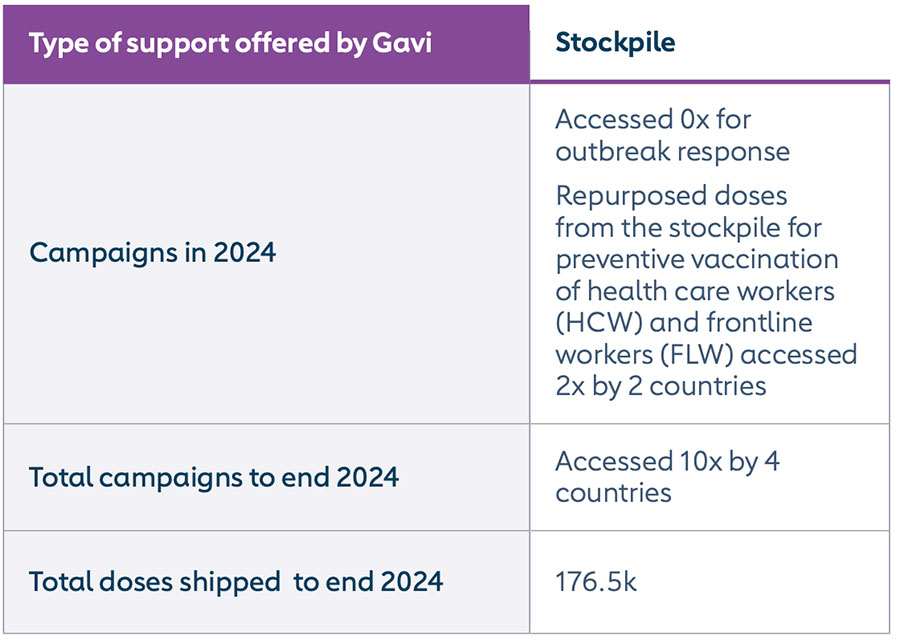
FROM GAVI'S 2024 ANNUAL PROGRESS REPORT:
More on Ebola vaccine
Read on VaccinesWork
How to apply for vaccine support
Latest Ebola news
Gavi commits additional funding for Ebola response
Gavi, the Vaccine Alliance will provide US$ 7 million to fund a shipment of 70,000 doses of the Ervebo vaccine to DRC.
Gavi, the Vaccine Alliance welcomes the news that the WHO Technical Advisory Group on candidate vaccine prioritization (TAG-CVP) for Bundibugyo virus disease (BVD) outbreak response recommends that the existing approved Ebola vaccine.
In a move designed to accelerate access to a vaccine against Bundibugyo Ebolavirus disease, UNICEF and Gavi, the Vaccine Alliance today announced the launch of a Request for Expression of Interest (EOI) to gather information from vaccine…