

Non-communicable diseases Global Action Plan recognises role of vaccination
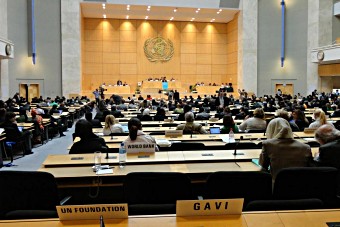
The 66th World Health Assembly took place in Geneva from 20-28 May 2013.
Geneva, 27 May 2013 – The frontline role of vaccination in fighting the rising number of premature deaths from noncommunicable diseases (NCDs) was recognised on Monday when WHO Member States (194 countries) endorsed the 2013-2020 NCD Global Action Plan and the Global Monitoring Framework for NCDs at the World Health Assembly (WHA).
The Global Monitoring Framework identifies vaccines against hepatitis B and human papillomavirus, key causes of liver and cervical cancer respectively, as two indicators of the Action Plan’s success in reaching its global target of a 25% reduction of NCDs by 2025.
NCDs, including cancer, are the world’s number one killer, accounting for 63 percent of all global deaths, with the largest burden occurring in low- and middle-income countries.
GAVI statement
Background to today’s decision
At a High-Level Meeting at the United Nations (UN) in September 2011, Governments issued a political declaration acknowledging non-communicable diseases (NCDs) as a global priority and committing to long-term action to address the crisis.
An ambitious global target was agreed to reduce premature deaths from NCDs by 25% by 2025. WHO has since led a series of consultations with Member States, UN agencies, NGOs, and the private sector to develop three elements of a new global NCD framework:
- Global Monitoring Framework for NCDs
- Global NCD Action Plan (2013-2020)
- Global Coordinating Mechanism for NCDs
Addressing WHA members on Monday, GAVI emphasised that the “the prevention of the infectious causes of cancer through hepB and HPV vaccines can help fight the rising global burden of cancer deaths. GAVI welcomes the inclusion of hepB and HPV vaccines as indicators in the global monitoring framework. Vaccines in child hood and adolescence offer the best opportunity to prevent liver and cervical cancer in adulthood.”
Both vaccines are supported by GAVI:
- HepB: in the past 10 years, the Alliance has supported the immunisation of 267 million infants against hepB in developing countries and prevented an estimated 3.8 million future deaths from liver cancer in the poorest countries of the world.
- HPV: Kenya recently became the first country to protect girls against cervical cancer with GAVI-supported HPV vaccines. By 2020, GAVI expects more than 30 million girls in over 40 of the world’s poorest countries to have been immunised with the HPV vaccine.
New development agenda
The monitoring framework, endorsed after a week of negotiations among WHO Member States, is expected to drive progress in prevention and control of NCDs. It will also provide the foundation for advocacy, raising awareness, reinforcing political commitment and promoting global action to tackle these deadly diseases.
The framework will help shape a new development agenda that advances the three dimensions of sustainable development: economic development, environmental sustainability, and social inclusion.